Ayurveda is science of Vedic medicine and wellbeing, a method of holistic healing from the ancient times. As a matter of fact, apart from a traditional way of therapy for various ailments, it is also considered as a spiritual science. There is a belief that ayurveda is a sub-branch or part of Vedas and the torch of knowledge have been passed on from one generation to the other through ages, similar to passing on of the Vedic literature and Vedic scriptures through memorization. Legends have that the knowledge of ayurveda was created by Lord Brahma, who is the creator of the universe. He further passed it onto Prajapati, who later passed it to Ashwini Kumari (the celestial twin physicians) and they passed it onto Lord Indra. According to the Charaka Samhita, the timeless knowledge of Ayurveda is reflected in every cycle of the universe's creation. In order to provide relief from humanity's suffering, Lord Vishnu Himself took the form of Lord Dhanvantari and gifted to mankind Ayurveda.
As per scriptures, Lord Dhanvantari is revered as the ‘Father of Ayurveda’. According to the Vedas and Puranas, He is the God of healing and medicine and physician or doctor for the Gods. In Sanatan Dharma Lord Dhanvantari is worshipped in order to receive his blessings of healing and relief from various diseases and ailments. Legends go that Kind Divodasa, an ancient king of Kashi was a manifestation of Lord Dhanvantari, He taught Ayurveda to a group of sages including the famous Indian surgeon Susruta. It is believed that Lord Dhanvantari emerged at the end of the 'Churning of the Ocean' carrying the precious nectar of immorality 'Amrit'. As per some ancient texts, He is regarded as one of the incarnations of Lord Vishnu.
Story of Lord Dhanvantri’s Manifestation
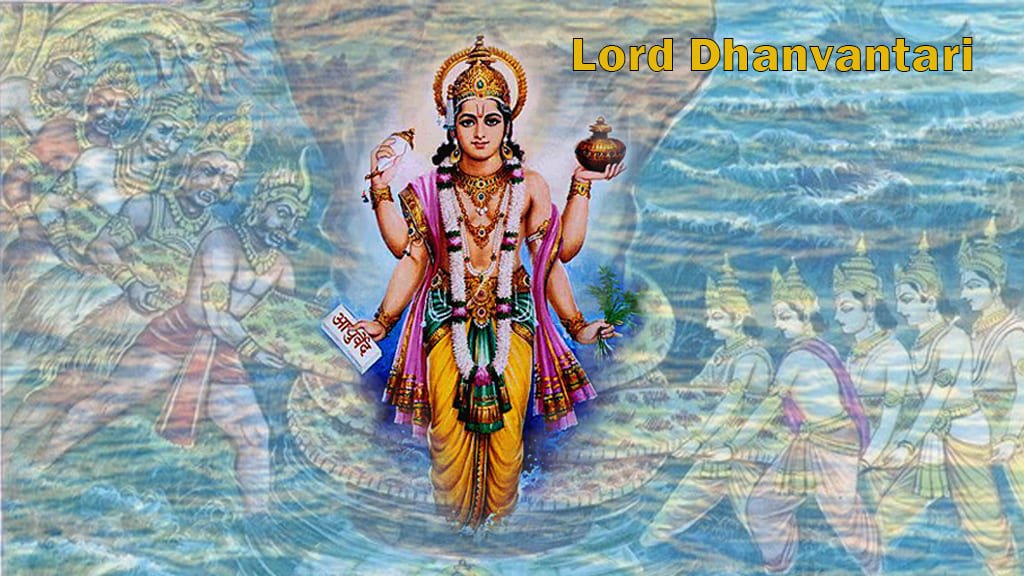
The story of Lord Dhanvantri’s origin is an interesting one and has great spiritual and Vedic significance. Bhagavata Purana states that both devas and asuras used the mountain Mandara as a pole and Vasuki, the serpent, as a cord to churn the ocean of milk. Various herbs were tossed into it. The churning was so difficult that Lord Vishnu had to appear in many avatars to assist them and keep the process moving forward. He even emerged as Lord Vishnu Himself, sitting on top of the mountain, to energize Indra and his companions.
The churning of the ocean eventually produced a lethal poison (halahala), which Lord Shiva consumed to save all creation. While he did so, His consort Goddess Parvati held his neck preventing the poison from reaching His stomach, and the halahala remained in Lord Shiva's throat, turning the color of his neck blue due to its power. This is why Lord Shiva is also known as Neelakantha meaning the Blue-Necked One.
Lord Dhanvantari emerged as the churning continued. His color was bluish black, his chest was broad, and he was young and firmly built. His fiery eyes and powerful arms gave him a lion-like stride. His hair was curly and oiled, and he had on him a bright yellow dress and pearl earrings that sparkled. He was carrying a conch, leeches, medicinal plants, a chakra (one of Lord Vishnu's sacred weapons), and the pot of ambrosia (nectar of immorality) that had been sought after.
Many Divine objects and beings surfaced from the ocean during the churning, such as Shri Lakshmi, the Goddess of Wealth, who was reunited with Her consort Lord Vishnu after being worshipped by all the Gods, devas, asuras, and everyone else present. Other Divine objects and beings that emerged from the ocean during the churning were Kamadhenu - the wish-fulfilling cow, Ucchaisrava - the white horse, Kaustubhamani - a rare diamond, Airavata and Kalpavriksha - the wish-fulfilling tree.
Seeing the nectar of immorality, the asuras overcome with greed and conceit, began fighting over who was going to drink the nectar first, stealing the pot from each other. Lord Vishnu took advantage of their distraction to deceive them, seeing just how preoccupied they were with their arguments. He assumed the enchanting form of Mohini, a mesmerizing woman who beguiled the demons, seized the nectar from them, and distributed it solely among the Gods. The demigods were energized and vanquished the demons as soon as they drank it. They returned to their place in the heavens after worshiping Lord Vishnu and Shri Laxmi.
Lord Vishnu predicted at the time of the churning that Lord Dhanvantari would reappear in the world to teach humanity the science of Ayurveda. Which is exactly what he did after Lord Indra requested Lord Dhanvantari to come to Earth and teach Ayurveda to mankind.
Meaning of the name Dhanvantri
The word Dhanvantri is a Sanskrit word made from words ‘Dhan’ meaning wealth and ‘Vantari’ meaning owner thus Dhanvantri means ‘one who owns great wealth’. Another meaning of the name is ‘oasis in the desert’ as dhanvan means desert. Lord Dhanvantari is considered as a Divine being or a sage by many. He is the symbol of healing and hope. His teachings emphasize the significance of living in tune with nature, maintaining a balance of mind, body, and spirit, and accepting the natural world's innate knowledge.
Lord Dhanvantri and History of Ayurveda
Ancient scriptures describe Lord Dhanvantari as a manifestation of Lord Vishnu, Divine healer or physician of Gods and the creator of Ayurveda. Today Lord Dhanvantari is worshipped for good health, wellbeing and healing and the day of his emergence from the ocean is celebrated as Dhanteras. Lord Dhanvantari made aware all that the knowledge of Ayurveda was created by Lord Brahma even before He created humans, and the said is available in the 1,000 chapters of the Atharvaveda. As it is difficult for the limited human mind to comprehend this knowledge Lord Dhanvantari reorganized classical Ayurveda into eight divisions namely Kaaya Chikitsa, Baala Chikitsa, Graha Chikitsa, Urdhvaanga Chikitsa, Shalya Chikitsa, Damstra Chikitsa, Jara Chikitsa and Vrsha Chikitsa.