Topmost Mysterious Temples of India
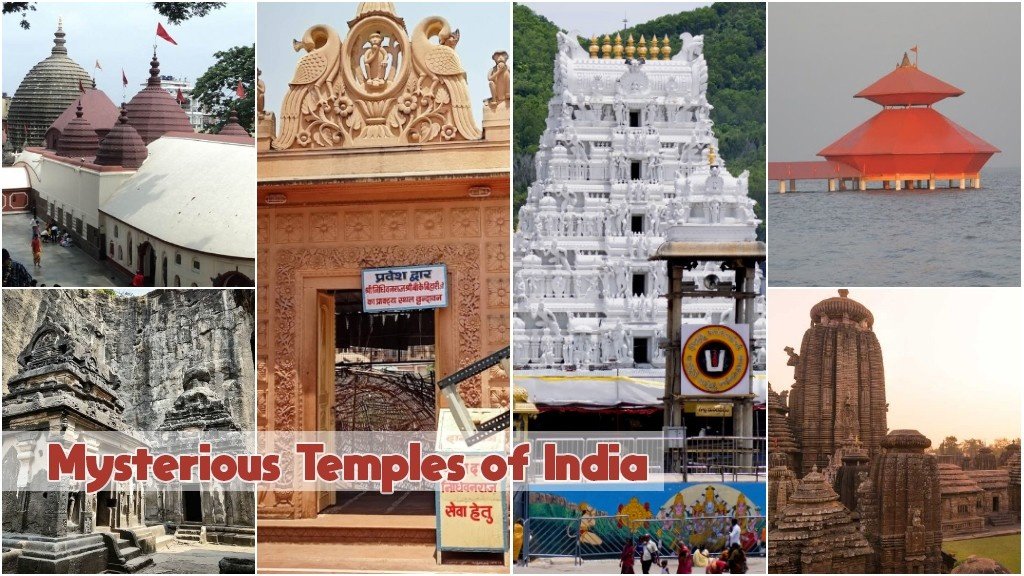
India or Bharat is home to one of the most ancient civilizations and religions on the planet. Both, Sanatan Dharma and the ancient Indian civilization are most vibrant, mystic, colorful and unique in many a sense. The land of Vedas, Upanishads and Puranas also hold numerous diversities in cultures, traditions and rituals across its length and breadth. This fact is also evident in food habits, customs, costumes, celebration and even architecture. But in the land one will feel that there is a bond or a thread that ties together people of varied and diverse traditions and beliefs. Like the stories and legends from the ancient scriptures spellbound people from across the land. Ancient sciences such as Vedic Astrology and Vastu Shastra are believed-in and practiced across North, South, East and West of India. Throughout the ages ancient architecture was dominated by magnificence and mighty temples which were built as per principals of Vastu Shastra and were home to various devotional and as well as mystic practices. Thus it is of no surprise that India is home to many mysterious temples whose mysteries are still intriguing till date. These temples hold in them many untold secrets, stories and unsolved puzzles. While visiting these temples, one will experience a mixed feeling of spiritual Divinity and spooky goosebumps. Listed below are some of the most enigmatic and intriguing temples of India.
Mehandipur Balaji Temple (Dausa, Rajasthan)
Not for the faint-hearted, the Mehandipur Balaji temple is a spooky and a unique pilgrimage site in Dausa, Rajasthan. It is one of the most unique, mysterious yet popular temples in all of India as here the priests perform exorcism rituals to rid a person of any kind of evil spirit or black magic. Imagine being a visitor at the temple and hearing the screams and cries of possessed men and women. It is, nevertheless, Lord Hanuman's abode. Hundreds of people travel to Mehandipur Balaji temple every day in hopes of healing a family member or relative who has been possessed by a spirit, ghost or black magic. Many people find their visit to this temple upsetting and unsettling due to scenes of people being chained or peculiar custom or ritual being carried out. This Mehandipur Balaji temple is not like any other temple in India. But as it is dedicated to Lord Hanuman, one may witness the Tuesday evening Aarti ceremony which is considered very powerful. It is believed here one shouldn’t strictly eat anything given by anybody within this temple premises. Also it is believed that one should never look back when he or she leaves the temple premises.
Kamakhya Devi Temple (Guwahati, Assam)
The Kamakhya Devi temple is one amongst the Shakti Peetha temples. The temple is located on Assam's Nilachal Hill. Here Goddess Shakti is worshipped in the form or shape of a yoni (vagina). The mysterious Kamakhya Devi Temple in Guwahati, India, celebrates womanhood and menstruation since the Goddess of this temple bleeds every year during the monsoon period. The century-old temple is considered as one of India's most popular and powerful amid the 51 Shakti Peethas. On entering the temple premises, one will witness a stone-shaped vagina, or ‘Yoni’ that is worshipped here by the devotees, instead of a Deity idol. Every year, the Goddess bleeds and turns the underground water reservoir red. Therefore, the temple is shut throughout this period. The temple is considered as an epicenter for cult, occult and tantric practices and the mysticism can be felt in the air here. Many devotees experience strange feelings, thoughts and occurrences after visiting the Kamakhya Devi Temple near Guwahati. Every year, during the monsoon, the Ambubachi festival is celebrated to honor the fertility of the Goddess for three days. The temple closes during that period and opens again on the fourth day.
Kailasa Temple (Ellora Caves, Maharashtra)
Kailasa Temple dates back to the 16th century, it is a huge rock-cut Hindu temple located in the Ellora Caves in the state of Maharashtra. This temple will inspire one to learn more about ancient Indian civilization, culture and mysticism than one ever have before. Kailasa Temple's structure is monolithic, meaning it has been built from a single rock. This three-story-tall temple edifice boasts beautiful sculptures that drew the attention of the tyrant Mughal King, Aurangzeb, who ordered the caves to be destroyed, yet the Kailasa Cave Temple remained intact. Everything about the temple is mysterious, so much so that people believe it was built by aliens or by humans having some unique alien technology as the temple is cut from top to bottom. The temple when viewed from air resembles a chariot; experts believe it is impossible for people in that day and age to have such construction technology. Also archeologists don’t know what happened to millions of tons of stones that would have been generated during the construction, it is believed that it just evaporated in thin air. The mystery also surrounds the time it took to construct temple the temple, some experts believe it was built in 14 years which is impossible others believe it to be 400 years but scriptural reference doesn’t collaborate this claim. An estimated thirty million Sanskrit carvings remain unidentified, according to archaeologists. Some claim that its mystery stems also from the fact that no one in today's world could create something so intricate. Some people believe the said temple has some connection with the Kailash Mountain in Tibet.
Nidhivan Temple (Vrindavan, Uttar Pradesh)
Located in Vrindavan in the Mathura district of Uttar Pradesh, Nidhivan is a sacred forest. For devotees of Lord Krishna and Maa Radha, Nidhivan is a unique and special place and experience. Nidhivan, often called the Forest of Tulsi, is a location that is shrouded in mystery. One cannot help but notice the twisted trees that are scattered around the forest floor in pairs when visiting Nidhivan. It is thought that these paired basil trees are gopis that come to life at night. Many believe that Lord Krishna come here to perform Raas Leela here after dusk. Devotees are not permitted to remain on the premises past dusk. It's said that anyone and everyone who has tried to watch what happens here either passes away, goes blind, or goes crazy.
Jagannath Temple (Puri, Odisha)
The Jagannath Temple in Puri, Odisha is most significant for every Lord Vishu devotees, it is also one of the Char Dham pilgrimage sites meaning one of the four primary and most sacred pilgrimages in Santan Dharma that a devotee must undertake in his life. The temple is also world-famous for its yearly Rath Yatra. According to many traditions, King Indradyumn established this sacred temple after Lord Vishnu blessed and directed him in his dreams to discover Nila Madhav. There are many mysteries that surround the temple, the first one being that defying natural laws, the flag atop the temple always flutters in the opposite direction of the wind. Another mystery about the temple is the 20-foot-tall and colossal Sudarshan Chakra situated atop the temple. The Chakra is visible from all directions and location in Puri and what is intriguing is that no matter from what location or place in Puri one views it from, it will seem that the Sudarshan Chakra is always facing towards them. One may believe the phenomenon to be an engineering marvel or placement and positioning trick but nevertheless the exact reason for the same still remains a mystery. Another unique and mysterious aspect of the temple is that the place is a no-fly zone designated by some spiritual force rather than any govt. authority as no birds here fly over the temple unlike in the neighborhood. The said occurrence also has no explanation and still remains a mystery.
Veerabhadra Temple (Lepakshi, Andra Pradesh)
The mysterious Veerabhadra Temple in the Lepakshi region of Andra Pradesh is famous for having one hanging pillar out of seventy. Its architecture reflects the Vijaynagar style of construction, and its history goes back to the sixteenth century. Andhra Pradesh's Veerabhadra Temple has gained popularity across the country due to its unique feature of having a single pillar hanging from the top, which attracts a lot of people. This temple is dedicated to Lord Kal Bhairav Nath, an incarnation of Lord Shiva, and dates back to the sixteenth century. A cloth can even be slipped beneath the hanging pillar to reveal the gap between it and the ground. One may explore and admire the stunning Goddesses and Deity sculptures on the pillars and the walls, and also be enchanted by the ancient engineering marvel as you tour the temple. This temple is a place where mystery and history converge.
Lingaraja Temple (Bhubaneshwar, Odisha)
The eleventh century Lingaraja Temple is dedicated to Lord Shiva. It is the largest temple in the city of Bhubaneswar. The incredible temple was presumably constructed by Jaipur's King, Jajati Keshari when he relocated his dynasty to Bhuvneshwar city around 1090 to 1104 C.E. This temple is unique and remarkable because of an optical illusion that makes it appear much bigger than it actually is. One will be captivated by the intricate designs of the temple, which features architecture in the Kalinga style. Inside is a unique Swayambhu Lingam which as per legends was not in the current lingam form in the Satya and Treta Yuga but took the said form in Dwapar and Kali Yuga. The temple has a long and rich history, the main gate is guarded by two yellow lions and here offering of milk and bhang by devotees to the Lingam is a tradition.
Sree Padmanabhaswamy Temple (Thiruvananthapuram, Kerala)
The mysterious Sree Padmanabhaswamy Temple is situated in the heart of Thiruvananthapuram, Kerala. There are several restrictions on entry to this holy place as only Hindus are permitted inside the temple premises. People of other religions are not permitted inside the temple in order to maintain its sanctity and purity. The temple is devoted to Lord Padmanabhaya, one of Lord Vishnu's avatars. Many think that coming to this shrine will grant their wishes. This ancient temple, which dates to the eighth century CE, was designed in the Chera architectural style. Keep in mind that there is a dress code before you go. Women should wear sarees, and men are required to wear dhotis. No modern clothing is permitted inside the temple. A trust headed by the Travancore Royal Family looks after the temple. The mystery surrounding the temple is about the treasures in cellars/vaults at this temple. Some believe it to be billions of dollars and more that GDP of many countries. There are also many myths, mysteries and legends associated with the said treasure of the temple. Some vaults are still not opened as experts believe opening them will harm the structure of the temple, thus nobody know what treasures are present in the temple. No wonder that the government has installed Z-Security to protect the treasures kept in the cellars.
Venkateshwara Temple (Tirumala, Andhra Pradesh)
The Venkateshwara Temple is another mysterious temple of India located in the Tirupati area of Andhra Pradesh. Every day, some 50,000 pilgrims come to worship Lord Venkateshwara, sometimes referred to as Lord Balaji, a manifestation of Lord Vishnu. The temple attracts devotees from around the world. The energy and aura at the temple is something unique and one to experience. The temple has an annual turnover of about 6.5 million USD, making it one of the richest temples in India. The mystery here is that the Deity idol here is known to perspire and have real hair. Surprisingly, despite the priests' constant efforts to dry it off, the back of the idol remains moist. Also what is interesting is that it is believed when one properly positions their ear on the back of the Deity, one can hear massive sea waves.
Ananthapadmanabha Lake Temple (Kasaragod, Kerala)
In Kasaragod, Kerala, located is the Ananthapadmanabha Lake Temple. The temple is mysterious and unique because of its crocodile protector, Babia. Unlike other crocodiles, this one is a vegetarian. The crocodile, Babia, protects the temple and till date has never hurts anyone. Babia exclusively consumes the temple prasad, which consists of cooked rice and jaggery, despite the fact that crocodiles have a reputation for being vicious meat eaters. After the midday prayer, devotees even give Babia food with their hands. It is astonishing that Babia, who has been a resident of the lake for approximately 70 years, gets along nicely with people. The impressive wood carvings at the temple, which depict scenes of Lord Vishnu's incarnations, date back to the ninth century. There is a unique relationship between Babia and the temple priest. Babia once emerged from the pond, but it turned around and went back in response to the priest's command. There are other fish in the pond besides Babia, and this vegan crocodile hasn't hurt any of them. It is believed that when one crocodile dies or vanishes it is replaced by another one by nature.
Meenakshi Amman Temple (Madurai, Tamil Nadu)
Meenakshi Amman Temple is an extraordinary landmark located in the very heart of Madurai, Tamil Nadu. Madurai city as a whole has a deep bond with this temple. Meenakshi sometimes referred to as Goddess Parvati, and Sundareswarar, Lord Shiva, are the presiding Deities of this temple. This temple is considered one of the most mysterious in India because of architectural, historical and religious significance. The mesmerizing architecture of the temple is a mystery in itself. Experts are still puzzled about the architectural, technical and engineering marvel the temple is and how it was constructed without advanced technology and tools in ancient times. The temple has a hall with musical pillars whose mechanism experts aren’t able to solve till date. Also the pillars remain cool even in scorching temperatures, how this is achieved is still a mystery. Meenakshi Amman Temple, which covers an enormous 14-acre area, is not just large but also exceptionally old, with sculptures dating back about 3000 years. Inside, there are around 33,000 sculptures and 4000 pillars, each crafted from a single rock. Carvings of mythical creatures such as a lion with elephant heads and more found throughout the temple complex add to mysticism and mystery of the temple.
Jwala Ji Temple, Himachal Pradesh
The Jwala Ji Temple is located in the Kangra district in the state of Himachal Pradesh. It is one of the Shakti Peethas dedicated to Goddess Shakti. It is believed here is where the tongue of Goddess Shakti fell when Lord Vishnu cut Her corpse using Sudarshan Chakra during Lord Shiva’s tandava. Here in the temple there is no typical Goddess Idol which is worshipped instead there is natural blue flames that emerge from rock fissures within a square sanctum pit which is worshipped as a representation of Goddess Shakti’s tongue. The mystery of the temple is the unexplained, Divine blue eternal flame. The flame has no visible fuel source and experts have failed to find definitive natural source. Legends go that Mughal Emperor Akbar attempted to extinguish the flame using iron plates and water channels but failed.
Kaal Bhairav Nath Temple (Ujjain, Madhya Pradesh)
The Kaal Bhairav Nath Temple in Varanasi, UP is dedicated to Lord Kaal Bhairav, a fierce manifestation of Lord Shiva. The mystery or the uniqueness of the temple here is that here, in place of the typical offerings; people offer the God wine or whiskey and in-turn are blessed with blessings of courage, confidence and fearlessness. The offering of alcohol poured in the Idol’s mouth mysteriously disappears. Here, you won't find the typical flower garlands or sweet shops. Before entering the shrine, devotees purchase these alcohols from booths outside. Be prepared for long queues particularly on important Hindu festivals, but the wait will surely be worthwhile.
Stambheshwar Mahadev Temple (Kavi Kamboi Village, Gujarat)
Stambheshwar Mahadev Temple is another mysterious temple, close to Vadodara, that emerges from water and vanishes in it. Lord Shiva is said to reside in this temple, therefore those who dare to enter are bestowed with His blessings. The Stambheshwar Temple is only open for visits during low tide. The temple vanishes into the sea during high tides and resurfaces when the water level drops.
Related posts
What Are Tarot Cards, History and Significance
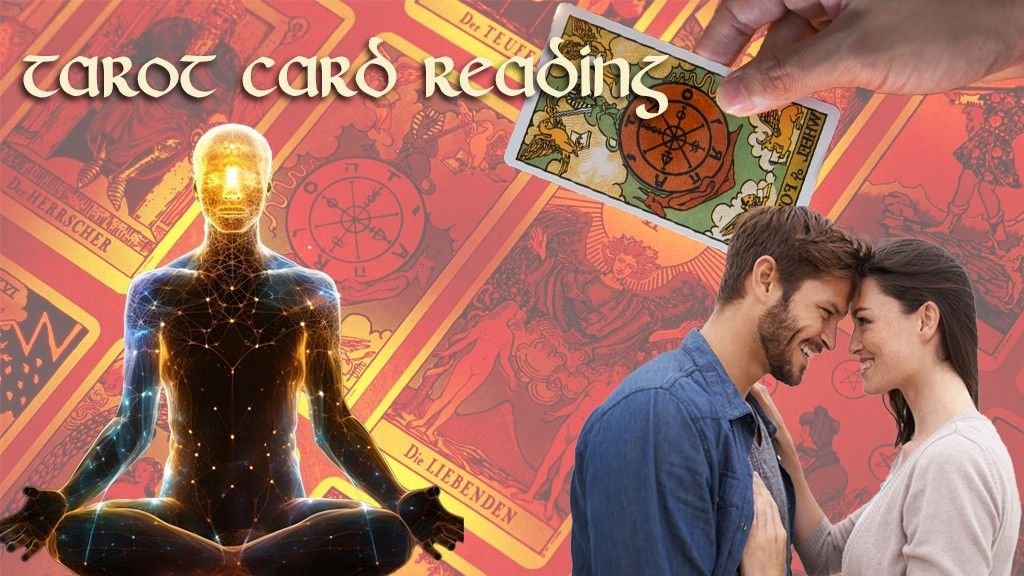
Tarot Cards are regarded as mystic tools which are used to gain insight into the past, present and future by formulating a question and then drawing and interpreting cards. In addition to being an intuitive tool, the Tarot is now acknowledged as a powerful instrument for personal development and much more. A standard tarot deck consists of 78 cards, divided into two main sections which are the Major Arcana (22 cards) and the Minor Arcana (56 cards). The Major Arcana includes iconic archetypes like The Fool, The Magician, and The Lovers, symbolizing major life themes and spiritual lessons. The Minor Arcana is further divided into four suits namely Cups, Pentacles, Swords, and Wands, each representing different aspects of daily life, emotions, and challenges.
What are Tarot Cards
Tarot Cards have been renowned for being a fortune-telling tool since ages. It has been commonly used for the said purpose as well, but in recent years, amateurs and experts alike have developed more complex methodologies for using the deck of 78 illustrated cards and use them for various purposes along with predicting the future. Reading a Tarot Card spread or layout is the art of seeking direction and knowledge through a particular card arrangement. Contrary to common perception, however, Tarot readings do not require psychic abilities (although it helps), nor do the cards just disclose the outcome of your life. The purpose of the cards is to help one gain insights and understanding of the higher self's deepest secrets. To put it differently, the cards offer a deeper understanding of what you already know deep inside.
History of Tarot Cards
Although the Tarot Cards' exact origins are unknown and uncertain, there are records of its usage dating back to the fourteenth century in the European continent. From the beginning of the seventeenth century, the Tarot has been used as an oracle in the basic type and form which is known today. During the Middle Ages, the cards were utilized as a game as well as for occult activity, which was widespread during that period of time. The Order of the Golden Dawn, a secret society and an esoteric organization founded in London and active in the late 19th and early 20th centuries, is largely responsible for the development of modern-day tarot. It is believed that Pamela Colman Smith, a talented artist and a member of the Golden Dawn was first to create the drawings of the cards on insistence and instructions of Arthur Edward Waite a fellow member. Many modern decks draw inspiration from the exquisite and deeply symbolic drawings of the Smith Waite deck, which has become a modern classic. The Thoth Tarot by Aleister Crowley and the Tarot of Marseille are two more traditional decks.
How do Tarot Cards Work
The Major Arcana consists of 22 cards that reveal broader, major and primary life themes, while the Minor Arcana consists of 56 cards that reveal minor life lessons and day-to-day happenings. The Minor Arcana is further split into four suits which are Wands, Swords, Cups, and Pentacles. Each suit consists of fourteen cards, numbered Ace through Ten, plus the Court Cards, which are Queen, King, Page (a princess), and Knight (a prince). Deck names can differ somewhat.
Though their names aren't always the same, the suits and the individual cards generally have the same basic meanings. For instance, the Knight in many decks represents the King rather than the Prince. You may use the guidebook that most decks come with to familiarize yourself with the details. The Tarot's Minor Arcana represents elements of daily life, providing insight into our daily struggles and experiences of highs and lows. The Swords represent Air element, Cups represent Water, Pentacles represent Earth, and the Wands represent Fire element. Each suit symbolizes one of the elements. The outfits can convey a person's attitude and character, such as whether they are fiery, ‘up in the air,’ or ‘down to earth.’ The question asked, the reader, the individual getting the reading and the arrangement of other cards in the spread all play a role in determining the importance of a particular card.
On a spread the Major Arcana cards are arranged in chronological order i.e. from 0 to 21, with The Fool at the beginning and The World at the finish. The Hero's Journey, which may be further explored with Joseph Campbell's book ‘The Hero with a Thousand Faces,’ is in line with the turning points of life's narrative and these cards reflect that. The Major Arcana cards, then, stand for the 22 inescapable stages or junctures of every journey that each of us will experience at some point in our lives.
These stages may also return and repeat themselves several times during a person's life, giving rise to a cyclical character that lacks a definitive beginning or finish.
Different types of Tarot Cards
The traditional 78-card tarot deck consists of 22 Major Arcana cards and 56 Minor Arcana cards.
The Major Arcana part discusses your life's karma and the spiritual learning that you will require to think about and develop as a person. You must give these cards careful thought since they contain a crucial message.
At the same time, the Minor Arcana addresses the everyday hardships that each of us faces in life. These cards teach you how to handle obstacles in your day-to-day life with ease and grace. Four additional card suits namely the Pentacles, Wands, Swords, and Cups are included in the Minor Arcana. With the help of these cards different interpretation and meaning can be given to happenings in one's life.
The Fool: When The Fool is drawn in a reading, it represents a period of fresh starts that call for bravery and a readiness to jump into a whole different cycle, stage, or aspect of life. The Fool is a symbol of the spirit of curiosity and innocence, representing the want for adventure.
The Magician: The magician is a master of time and communication. Pulling The Magician represents a period when you can use your voice, words, brains, and capacity to express ideas to make things happen. Now is the moment to work your own magic.
The High Priestess: Symbolizing intuition, mystery, and the subconscious, she invites you to trust your inner voice and explore hidden truths beyond the surface.
The Empress: The Empress signifies the ability to offer and receive love and care in a balanced manner. It symbolizes abundance, fertility and nurturing. It also represents growth and creativity.
The Emperor: Your ability to lead and exercise personal authority is shown when you pull the emperor. He is a reflection of your ability to take initiative, be bold, and lead. When it's time to take charge and become your own boss, the emperor often makes an appearance.
The Hierophant: The Hierophant is the card of spiritual teaching and learning that can help us face the religion, customs, and ideas we have accepted. He may represent a period of spiritual development or initiation or the arrival of a teacher or mentor in your life.
The Lovers: The Lovers card represents the art of relationships, both internal and external. It is the joining of opposites, a bringing together of two things, and it might represent the necessity of choosing between two circumstances or individuals. The Lovers challenges you to consider how you approach, select, and give yourself over to love.
The Chariot: The Chariot represents progress, upward movement, drive, letting go of the past to go on, resolve, notoriety, drawing confidence, and feeling secure in your chosen course.
The Strength: Strength is this stage of human growth, where we are all learning how to reconcile our innately animalistic primal nature with our socially conscious civilized selves. You are called to express your originality, passion, and instincts when you pull Strength. You're going to feel energized and full of life again.
The Hermit: The Hermit is a symbol of your inner knowledge and capacity to illuminate your own path; he holds the Star of Hope in his lantern. Presumably, you are about to embark on a period of introspection and seclusion during which the following steps will become clear. Take some time to explore your inner self without outside distractions.
Wheel of Fortune: For those who trust and let the movement lead them to new opportunities, the Wheel spins in favorable ways. Be open to success and breakthrough when you turn the wheel. Be open to venturing into the uncharted territory, where one may encounter "luck" in the shape of novel experiences.
Justice: You enter a state of balance and realignment when Justice displays itself. It's time to take stock of your situation and let go of some of the stuff that has been keeping you off balance. Justice seeks equilibrium in all spheres of life, including work, relationships, health, and wealth.
The Hanged Man: Signifying surrender, new perspectives, and spiritual awakening, he reminds you that true insight often comes through letting go and embracing stillness.
Death: When you let go of what has already passed away, death is the card of rebirth that appears. This card isn't usually associated with physical death; rather, it's a call to release yourself from the burden of death and enter a new stage of life. You powerfully renew yourself in this way.
Temperance: Things are starting to come together when you pull Temperance; you are either going through or soon will go through an integration phase. Even while it may seem like nothing is going on the outside, you are actively alchemically making something new that will eventually appear.
The Devil: It appears that the Devil mocks us, and this card serves as a helpful reminder to not take life too seriously. It is we who bind ourselves with fears, judgments, and expectations. The Devil serves as both a lesson to chuckle at how we ‘bedevil’ ourselves and a cautionary tale about accepting responsibility for our worldly inclinations and ambitions.
The Tower: It's time to demolish the broken and construct something fresh. The Tower serves as a warning. Anything that isn't in line with your actual desires, nature, or purpose can be undone by you. It's time to make a life renovation.
The Star: Discover the revitalizing power of optimism and a new perspective as you pull The Star. You are being reminded of the valuable contribution you make to society and the distinctive ways in which you shine. Make the most of your recovery period, particularly with regard to your self-worth. It's possible that you'll be recognized by the public.
The Moon: The Moon urges you to accept the mystery and everything that defies explanation or definition. When The Moon shows up in a reading, sometimes you won't immediately understand. Maybe now isn't the right moment to find out. It's possible that you'll be drawn to the depths of your spirit, where feelings and visions await your interpretation.
The Sun: Prepare to shine in ways that uplift and encourage others when you apply The Sun, the co-creation principle. You are a sun for others on the globe, just as the Sun is a source of warmth and light for us in our solar system. Give up on things that make you feel exhausted. Team up with people who make you happy to be alive and follow your heart.
Judgement: The use of sound judgment is crucial, and reading judgment emphasizes the value of having a wide viewpoint, impartiality, and fairness. It might be time to examine how you and judgment interact. All of this is a means to an awakening or rebirth, from which you can re-emerge, changed.
The World: It symbolized the ending of a particular cycle and a new beginning. And realizing and experiencing that everything is interconnected is the new cycle. It is fullness, the sum of all things. You have boundless potential to travel, share your gifts with the world, and take part in the cosmic dance.
After pulling a card from the spread and depending upon the guidance which is sought a gifted reader then interpret the symbolism, imagery, and positions of the cards in spreads (patterns) to provide guidance, clarity, and perspective. Whether used spiritually or analytically, tarot cards continue to be a popular and meaningful method for exploring intuition, making decisions, and understanding life’s complexities.
What is Mangal Dosha – Causes, Effects and Remedies
As per Vedic Astrology, life of an individual is heavily impacted by various planetary positions and movements in his natal chart. Conjunction and placements of Planets can lead to auspicious as well as malefic combinations being formed in the horoscope; these are known as Yogas and Doshas. There are numerous malefic Doshas which can be formed due to various Planets of the Navgraha. Some of these are much harmful whereas others can be milder. One such Dosha which impacts many Kundlis is the Manglik Dosha or the Kuja Dosha. In Vedic Astrology, Mangal or Planet Mars is a powerful Planet thus the Manglik Dosha holds a great significance. The Dosha can have several negative impacts on the native but it is especially known for the nuisance it creates for individuals looking to get married or in one’s married life.
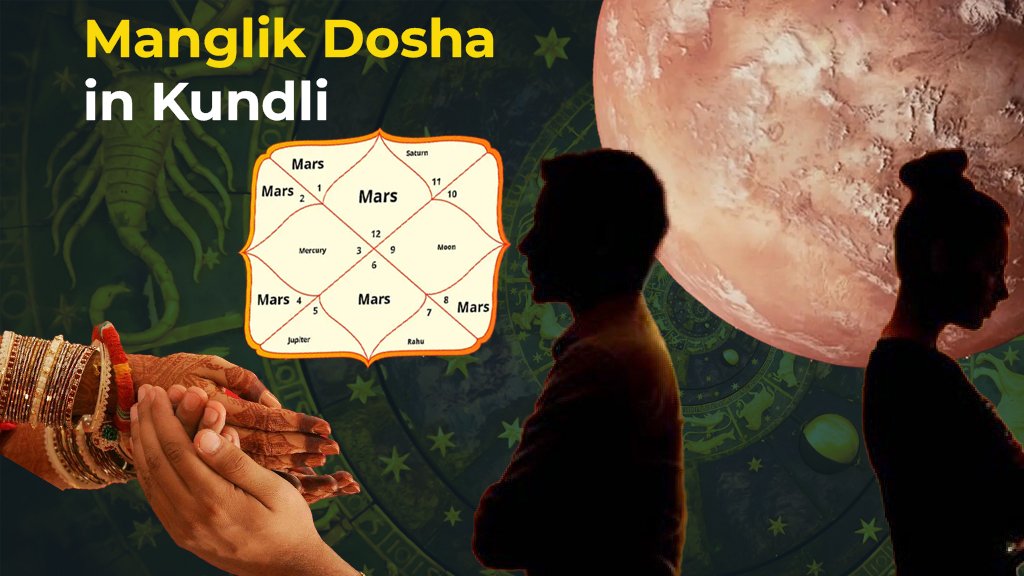
When the Planet Mars is weakly placed in the birth chart especially in houses 1st, 2nd, 4th, 7th, 8th, or 12th, the person is said to suffer from Manglik Dosha. Different placements of Planet Mars and also placement of other planets in the chart may determine the intensity and strength of the Dosha. Primarily the Manglik Dosha causes delay in marriage, it will create obstacles and hurdles in getting an ideal life partner. Another issue is that in Vedic Astrology it is recommended that a person with Manglik Dosha in his or her Kundli should marry somebody who also has the said Dosha as then the Dosha cancels itself out.
About Mangal Dosha / Manglik Dosha
Planet Mars or Mangal Dev is considered as the God of War. The red Planet blesses natives with self-confidence, purpose, vigor, fearlessness and zeal. It is also related with power, anger, courage and good fortune. A weakly placed Mars in Kundli can make a person egoistic, self-centered and conceited. Thus it is stated that a person who has Mangal Dosha in his natal chart shouldn’t marry a non-manglik person as it will be difficult for them to have a happy and long married life. Mangal Dosha in the Kundli of one of either husband or wife can cause issues such as sufferings, health issues, financial problems, obstacles, mental stress and in extreme cases it can even result in death or separation. Therefore, it is often advised that a Manglik individual should get married to another Manglik person. It is essential to consult a learned and knowledgeable Vedic Astrologer as he or she may guide whether the match can go ahead with undertaking or remedies or it should be avoided altogether. Also it is believed that the Manglik Dosha has strong impact only till the age of 28 years for a native after which its strength diminishes.
What Causes Mangal Dosha
It is important to first try to understand how and why Manglik Doshs forms in a Kundli. Planet Mars is a fiery and aggressive planet, when placed in the 1st, 2nd, 4th, 7th, 8th, or 12th house it causes energy imbalance which has a negative impact and bring challenges in marriage, such as delays, conflicts or disharmony. A person with Mangal Dosha is his or her Kundli will be incompatible with somebody who isn’t Manglik. Thus it is generally accepted that a Manglik should only marry a Manglik, which cancels the malefic effects of the dosha. Mangal Dosh can cause issues such as early marriage, late marriage, broken marriage and martial discords, thus the Mangal Dosha is considered very malefic and dangerous. But there are also unique remedies that can be done to negate the malefic effects of the Mangal Dosha. Some of these remedies include that the native first symbolically marry a kumbh (wooden pot), peepal tree or Shaligram. This way the said articles will absorb the Dosha’s malefic effects.
Effects of Planet Mars (Mangal Graha) in Different Houses
Mars in First House
When Mars is placed in first house which is referred to as the ‘House of Self’ it causes pointless arguments. This tendency is more likely to occur when a non-Manglik marries a Manglik. This will eventually cause needless stress, anxiety and compatibility issues which will negatively impact the marriage.
Mars in Second House
When Mars is placed in second house there will be a steady rise in disputes. Mars in second house causes career and family issue. There are chances that the native’s married life and career would suffer as a result of Mangal Dosha. Their family's lives is negatively impacted as well due to underlying issues.
Mars in Fourth House
Professional issues are likely to occur when Mars is placed in the fourth house and is active and aggressive. These problems will eventually make the native unhappy with his professional career causing financial hardships, resulting in adverse impact of family and family life.
Mars in Seventh House
When Mars is Placed in the seventh house, it makes individual aggressive and angry. He may have a negative outlook towards things and thus it is difficult for them to have a fruitful and positive relationship with their spouse and other family members. They will also try to dominate and dictate others causing issues and problems.
Mars in Eight House
Mars in the eighth house indicates that the individual will be lethargic and unproductive. He may have a higher chance of straying in a relationship. He will also be uncompromising or adjusting in a relationship causing issues for the spouse.
Mars in Twelfth House
Mars placed in twelfth house can lead to many issues such as health problems, financial issues, extramarital affairs and mental stress. It is difficult for such individuals to be in a productive and cordial relationship.
Mangal Dosha is Kundli is pretty common with around 40 – 50% of all Kundli suffering from the same according to some estimates. Many a times Mangal Dosha is not as horrible and malefic as it is made out to be. The strength of the Dosha depends upon a number of factors such as placement of other planets and more. It’s vital to consult an experienced astrologer for Kundli milap if any of the husband or wife has Mangal Dosha in the Kundli. He may recommend one of the below mentioned appropriate remedy to undertake to pacify the malefic effects of the Dosha.
Remedies for Mangal Dosha
Mangal Dosha is also called Kuja Dosha, Bhom Dosha, or Angarakha Dosha. It is a common dosha that can affect both men and women. This dosha generally influences married life by generating difficulties and conflict, occasionally which can result in separation and divorce. Mangal Dosha also indicates financial and professional difficulties. However, one has no reason to be worried about the unfavorable effects of this dosha because there are some remedies that can help to cancel out the negative effects of Mangal. There are specific rituals and chants that can be performed. Here's a list.
Mangal Dosh Nivaran Puja
In the Puja, Lord Mangal Dev is invoked and worshipped. His blessings are sought and mantra Jaap done to appease Mangal Graha and nullify the malefic effects of the Mangal Dosha.
Kumbh Vivah
Kumbh Vivah is a ritual performed to negate the malefic effects of Mangal dosha when one partner in a marriage is Manglik. In the ritual the partner who is Manglik is first symbolically married to an earthen pot and after the ceremony the earthen pot is broken. There are some variations of the ritual which in a Peepal tree or a banana tree or a Shaligram or a Lord Vishnu’s image is used instead of the clay pot.
Fasting / Chanting Mangal Mantra
Fasting and chanting of the Mangal Mantra on every Tuesday is considered as a potent remedy to mitigate the Mangal Dosha.
Donations / Offerings
Donating to the poor and the needy especially on a Tuesday is considered beneficial for an individual who is Manglik. Offerings of red clothes, food items especially red lentils and jaggery is considered helpful. Visit to a Navgraha temple is also considered beneficial.
Worshipping Lord Hanuman
Worshipping Lord Hanuman can also be beneficial in eliminating the negative effects of Mangal Dosha. Since Lord Hanuman is believed to be protector of Planet Mars. Natives having this dosha must regularly worship Lord Hanuman, especially on Tuesdays and Saturdays. Chanting Hanuman Chalisa or Bajrang Baan mantra is also helpful.
Wearing Red Coral Gemstone / 6 mukhi Rudraksha Bead
To pacify Mangal Dosha wearing of an energized Red Coral gemstone or a 6 mukhi Rudraksha bead is another excellent remedy. It is of utmost importance to first consult a learned astrologer and get the horoscope analyzed before wearing a gemstone.
Category