Pitru Dosha – Causes, Symptoms, Remedies
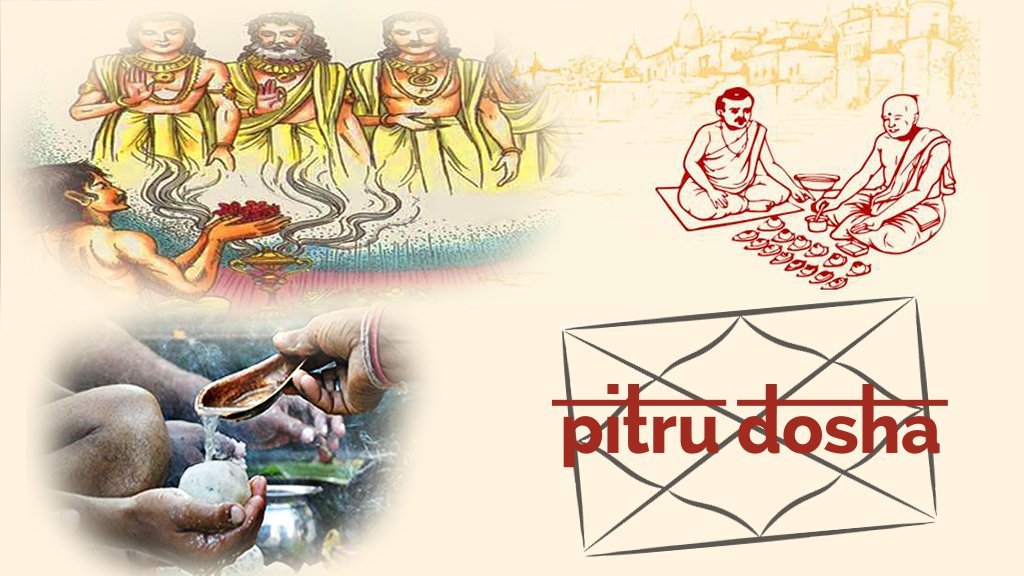
Pitru Dosha or Pitra Dosh is a common yet a highly malefic Dosha. Pitru means ‘forefathers or ancestors’ and Dosha mean ‘defect or problem’. The Dosha is caused due to unsatisfied departed souls of one’s forefathers. As per scriptures many a times when a person dies an unnatural or untimely death like in an accident or he dies with an unfulfilled desire or doesn’t receive proper list rites and ritual of antyeshti and shraddh or due to negative karma done in their lifetimes, the onward journey of such souls is troubled which causes miseries to both the departed and the family left behind. For any individual the reason for Pitru Dosh in Kundli is karmic debt and imbalance also known as Pitru rin or ancestral debt which needs to be settled. It is often exhibited in the Kundli by specific planetary combinations commonly involving the Sun, Moon, Rahu, Ketu or the ninth house (house of ancestors). Pitru Dosh is said to manifest as obstacles in career, marriage delays, financial issues, health problems, mental stress and recurring family problems. It is regarded as one of the top three most malefic dosha that can occur in the natal birth of an individual.
Effects of Pitra Dosh in Kundli
Depending upon conjunction and placement of various planets causing the Pitra Dosh in Kundli, the impact and severity of the malefic effects can vary for a native. A learned and knowledgeable astrologer can analyze the birth chart and provide more insights about the nature of the dosha in the native’s kundli. Pitra Dosh is a malefic dosha that can cause mental, physical and emotional sufferings. Malefic effects of the Pitra Dosh in Kundli can manifest in various aspects of life, often creating persistent obstacles, delays and hurdles. Natives with this dosh may experience repeated financial losses, mental stress, career stagnation, or obstacles in business despite hard work. It can cause delays in marriage, disharmony in relationships, or issues in conceiving children. Health problems especially recurring or hereditary ailments may also be seen in the family. In some cases, disputes over ancestral property or lack of unity among family members arise.
Types and Signs of Pitra Dosh
Sometimes various Pitru Dosh formed in various kundlis are classified as per their karmic and astrological reasons, they are generally classified into the following main types:
Karmic Pitru Dosh – Caused by negative karma and wrong deeds or sins committed by one’s ancestors.
Astrological Pitru Dosh – Forms due to specific planetary combinations especially in the ninth house (house of ancestors)
Shraddha/Tarpan Neglect Pitru Dosh – Occurs when proper ancestral rites, Shraddha, or Tarpan have not been performed
Unnatural Death Pitru Dosh – Caused when an ancestor suffered a violent or untimely death.
Matrutru Dosh – Pitru Dosh but linked to the maternal lineage
Also, there are some tell-tale signs that reveal that an individual may be suffering from Pitru Dosha. If one finds below issues and problems with self or with someone in family, then they should get their natal chart analyzed for Pitru Dosha.
Constant obstacles and hurdles in both personal and professional life
Delay in marriage or issues in conceiving a child
Financial problems such as debt and constant financial issues
Recurring health issues, diseases and ailments in family
Constant stress and conflicts in family without any major reason
Issues in career, education, growth and success
Recurring dreams of snakes or that of deceased family members
Planetary Positions that form the Pitra Dosh
When analyzing the horoscope for Pitra Dosh, a Vedic Astrologer will look for below mentioned planetary positions in the natal chart to determine Pitru Dosha.
1. Pitru Dosh forms in a kundli when the ninth house or its ruling planet comes under conjunction or opposition with Rahu or Ketu in a birth chart.
2. It may also be indicated when the Sun, Jupiter, Rahu, and Ketu are positioned in such a way that they conjoin or directly oppose each other in the horoscope.
3. Pitru dosh can manifest if Rahu is placed in the ascendant while the ascendant’s ruling planet resides in the sixth, eighth, or twelfth house.
4. When the ruler of the sixth, eighth, or twelfth house aligns with or opposes the planets involved in forming Pitru Dosh.
Pitra Dosh Remedies
Below are some popular remedies recommended to mitigate malefic effects of the Pitru Dosha:
Pitru Dosh Nivaran Puja
Pitru Dosh Nivaran Puja is recommended as the most potent way to nullify the malefic effects of the Pitru Dosh. The Puja can be conducted at home or in a temple. During the Puja Pitra Dosh Nivaran Mantra Jaap is done, along with rituals such as pind daan and tarpan.
Shraddh Puja during Pitru Paksha
Pitru Paksha is a 15 days period dedicated to venerating one’s ancestors. Shraddh Puja done during this period complete with pind daan and tarpan helps remove the Pitra Dosh.
Donation and Brahmin Bhoj
Charity or donation to the poor and needy, also brahmin bhoj meaning feeding of Brahmins ensure their blessings and removal of the malefic effects of the Dosha. Feeding of cows is also recommended.
Wearing of Appropriate Gemstone and Rudraksha
Wearing to appropriate gemstone or Rudraksha bead to strength position of certain planets can also help reduce the malefic impact of Pitra Dosh. However, one should first consult a knowledgeable astrologer before wearing the gemstone or rudraksha to know the correct methodology of using the same.
Related posts
Lord Dhanvantari Story and History of Ayurveda
Ayurveda is science of Vedic medicine and wellbeing, a method of holistic healing from the ancient times. As a matter of fact, apart from a traditional way of therapy for various ailments, it is also considered as a spiritual science. There is a belief that ayurveda is a sub-branch or part of Vedas and the torch of knowledge have been passed on from one generation to the other through ages, similar to passing on of the Vedic literature and Vedic scriptures through memorization. Legends have that the knowledge of ayurveda was created by Lord Brahma, who is the creator of the universe. He further passed it onto Prajapati, who later passed it to Ashwini Kumari (the celestial twin physicians) and they passed it onto Lord Indra. According to the Charaka Samhita, the timeless knowledge of Ayurveda is reflected in every cycle of the universe's creation. In order to provide relief from humanity's suffering, Lord Vishnu Himself took the form of Lord Dhanvantari and gifted to mankind Ayurveda.
As per scriptures, Lord Dhanvantari is revered as the ‘Father of Ayurveda’. According to the Vedas and Puranas, He is the God of healing and medicine and physician or doctor for the Gods. In Sanatan Dharma Lord Dhanvantari is worshipped in order to receive his blessings of healing and relief from various diseases and ailments. Legends go that Kind Divodasa, an ancient king of Kashi was a manifestation of Lord Dhanvantari, He taught Ayurveda to a group of sages including the famous Indian surgeon Susruta. It is believed that Lord Dhanvantari emerged at the end of the 'Churning of the Ocean' carrying the precious nectar of immorality 'Amrit'. As per some ancient texts, He is regarded as one of the incarnations of Lord Vishnu.
Story of Lord Dhanvantri’s Manifestation
The story of Lord Dhanvantri’s origin is an interesting one and has great spiritual and Vedic significance. Bhagavata Purana states that both devas and asuras used the mountain Mandara as a pole and Vasuki, the serpent, as a cord to churn the ocean of milk. Various herbs were tossed into it. The churning was so difficult that Lord Vishnu had to appear in many avatars to assist them and keep the process moving forward. He even emerged as Lord Vishnu Himself, sitting on top of the mountain, to energize Indra and his companions.
The churning of the ocean eventually produced a lethal poison (halahala), which Lord Shiva consumed to save all creation. While he did so, His consort Goddess Parvati held his neck preventing the poison from reaching His stomach, and the halahala remained in Lord Shiva's throat, turning the color of his neck blue due to its power. This is why Lord Shiva is also known as Neelakantha meaning the Blue-Necked One.
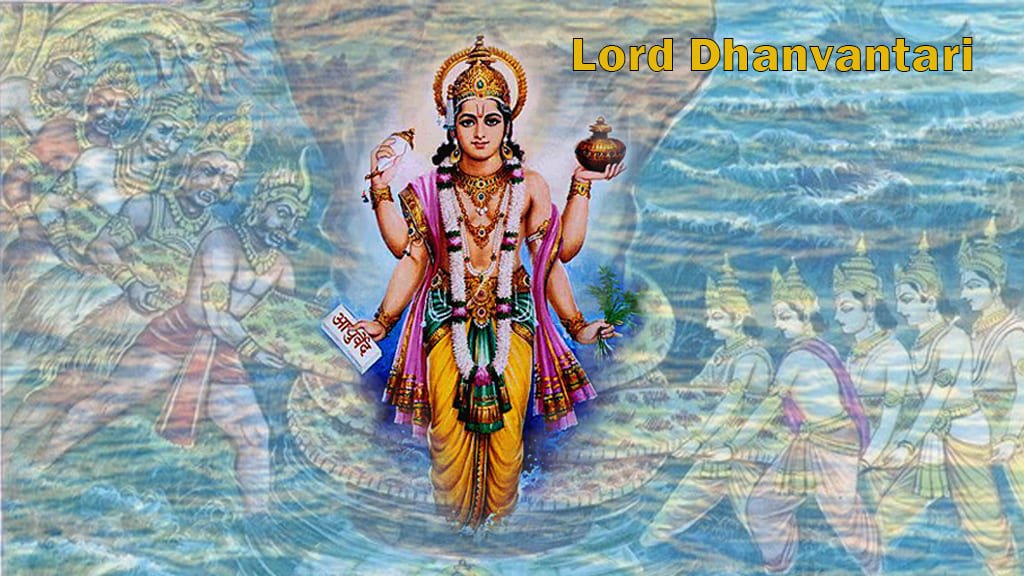
Lord Dhanvantari emerged as the churning continued. His color was bluish black, his chest was broad, and he was young and firmly built. His fiery eyes and powerful arms gave him a lion-like stride. His hair was curly and oiled, and he had on him a bright yellow dress and pearl earrings that sparkled. He was carrying a conch, leeches, medicinal plants, a chakra (one of Lord Vishnu's sacred weapons), and the pot of ambrosia (nectar of immorality) that had been sought after.
Many Divine objects and beings surfaced from the ocean during the churning, such as Shri Lakshmi, the Goddess of Wealth, who was reunited with Her consort Lord Vishnu after being worshipped by all the Gods, devas, asuras, and everyone else present. Other Divine objects and beings that emerged from the ocean during the churning were Kamadhenu - the wish-fulfilling cow, Ucchaisrava - the white horse, Kaustubhamani - a rare diamond, Airavata and Kalpavriksha - the wish-fulfilling tree.
Seeing the nectar of immorality, the asuras overcome with greed and conceit, began fighting over who was going to drink the nectar first, stealing the pot from each other. Lord Vishnu took advantage of their distraction to deceive them, seeing just how preoccupied they were with their arguments. He assumed the enchanting form of Mohini, a mesmerizing woman who beguiled the demons, seized the nectar from them, and distributed it solely among the Gods. The demigods were energized and vanquished the demons as soon as they drank it. They returned to their place in the heavens after worshiping Lord Vishnu and Shri Laxmi.
Lord Vishnu predicted at the time of the churning that Lord Dhanvantari would reappear in the world to teach humanity the science of Ayurveda. Which is exactly what he did after Lord Indra requested Lord Dhanvantari to come to Earth and teach Ayurveda to mankind.
Meaning of the name Dhanvantri
The word Dhanvantri is a Sanskrit word made from words ‘Dhan’ meaning wealth and ‘Vantari’ meaning owner thus Dhanvantri means ‘one who owns great wealth’. Another meaning of the name is ‘oasis in the desert’ as dhanvan means desert. Lord Dhanvantari is considered as a Divine being or a sage by many. He is the symbol of healing and hope. His teachings emphasize the significance of living in tune with nature, maintaining a balance of mind, body, and spirit, and accepting the natural world's innate knowledge.
Lord Dhanvantri and History of Ayurveda
Ancient scriptures describe Lord Dhanvantari as a manifestation of Lord Vishnu, Divine healer or physician of Gods and the creator of Ayurveda. Today Lord Dhanvantari is worshipped for good health, wellbeing and healing and the day of his emergence from the ocean is celebrated as Dhanteras. Lord Dhanvantari made aware all that the knowledge of Ayurveda was created by Lord Brahma even before He created humans, and the said is available in the 1,000 chapters of the Atharvaveda. As it is difficult for the limited human mind to comprehend this knowledge Lord Dhanvantari reorganized classical Ayurveda into eight divisions namely Kaaya Chikitsa, Baala Chikitsa, Graha Chikitsa, Urdhvaanga Chikitsa, Shalya Chikitsa, Damstra Chikitsa, Jara Chikitsa and Vrsha Chikitsa.
Panchmahabhootas (Five Elements) in Vastu Shastra
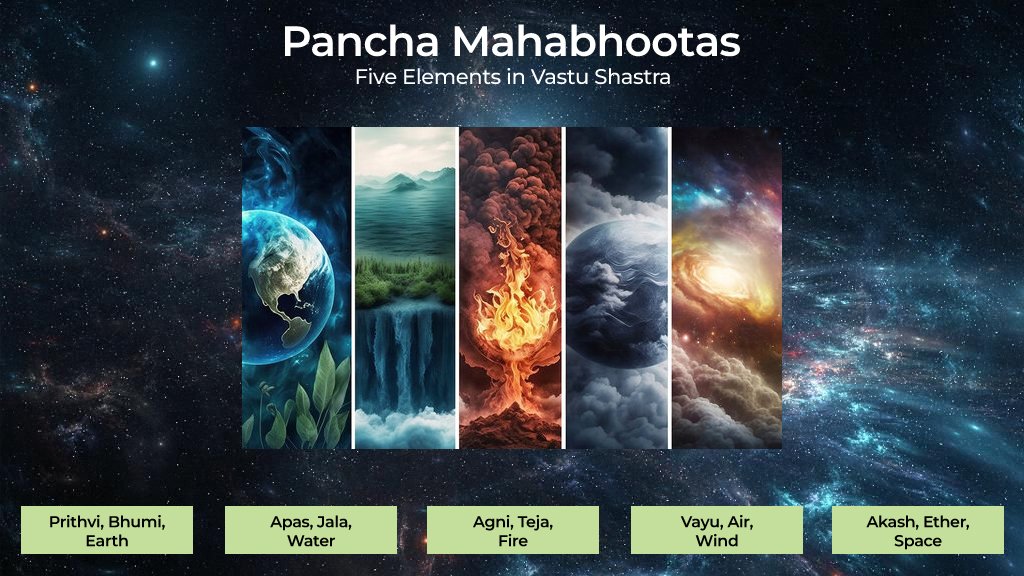
Panchmahabhoota can be loosely translated as ‘five great elements’. They refer to as five elements or five fundamental building blocks of nature or the material universe. The Panchmahabhoota are Air (Vayu), Water (Jal), Fire (Agni), Earth (Prithvi) and Space (Aakash). According to ancient Vedic wisdom, all living and non-living things are made from these five elements in varying proportions, and balance among them is essential for health, harmony and cosmic order. The concept of Panchmahabhoota or Panchtatva is widely used in Ayurveda, Yoga and Vastu Shastra. The Vastu Shastra is the ancient science of architecture and construction. The science dates back to more than 5000 years and primarily focuses on the principle of harmony, balance and alignment with the nature. As per Vastu Shastra, everything in the Universe including the human body is composed of five elements which are known as Panch Mahabhootas or the Panchtattva.
All creation in the Universe, be it planets or stars or any type of life form has a profound connection with the five elements. Each of the five elements has an important and distinct quality which is stability (earth), fluidity (Jal), transformation (fire), movement (air) and expansiveness (space). The balance of the 5 elements within the body and outside environment is considered essential for health, harmony and growth. The five elements are also connected with our five senses. Vastu Shastra states that all the Panchmahabhootas are constantly and intrinsically interrelated. Thus it is of utmost importance that during construction or designing balance of the Panchtatva with respect of various directions are understood and given ample thought. Complying with the principals of Vastu Shastra will ensure balance, positivity, good health and good fortune in the dwelling. On the other hand construction against the principals of Vastu will cause negativity, discord and disharmony.
Space (Akash)
Akash or space is the first element amongst the Panchmahabhootas. We all know the unique qualities of the space element which are expansion, vastness and void. The entire universe including us exists in this celestial empty space. The remaining four elements strategically and skillfully exist and interact in this first element. In Vastu Shastra, the Brahamsthana or the center of the construction and west direction is associated with the space element. The Akash element represents expansion of consciousness, clarity, growth, progress and connection to the infinite. A balanced space element fosters openness, creativity, and inner peace, while imbalance can lead to feelings of emptiness or isolation. One may maximize benefits of the space element by creating or maintaining adequate open spaces and keeping the dwelling clutter free promoting peace and tranquility. From space elements comes the second element which is Vayu (Air).
Air (Vayu)
The Vayu or the air element is the second amongst the Panchmahabhootas. The unique qualities of the Vayu element are movement, creativity, communication, flow, sense of touch and sound. After space element, air the second most important element in nature. Air element is associated with East and East-North-East directions. Thus in Vastu Shastra it is recommended to keep the said directions properly ventilated and airy. This ensures good health and overall wellbeing. The vayu element is also associated with joy, refreshment, fun, pleasure, happiness. But the most vital association of the Vayu element is that of life, growth and creativity. Blockages and imbalances for the Vayu element cause stress and mental agony for the residents of a dwelling. From the Vayu element comes the Fire or Agni Tatva.
Fire (Agni)
Fire of the Agni tatva is considered as the element of transformation and energy. The two primary features of this element are, heat and light. The unique qualities of the Agni element are energy, passion and transformation. The directions associated with the element are South-East and South directions. The fire elements is often related with the Sun, just like the vayu elements it is impossible for any life form to exist on earth without the energy of heat and light from the sun. Fire element is the first element that displays qualities such as color, shape, size and more. Fire element is associated with transformation of day to night, and also change of seasons. In Vastu Shastra balanced fire elements blesses residents of a dwelling with vigor, zeal, confidence, passion, name, fame and power. From the Fire element comes the Jal or water Tatva.
Water (Jal)
Among the Panch Mahabhootas, Jal or water element is the scarcest element. The North and the Northeast directions are associated with the water element. The unique qualities of the water element are touch, sound, shape and taste. Water can take all three forms namely liquid (water form), ice (solid form) and vapor (gas form). Water has a tendency to flow downward and also change shape in response to temperature changes. In its purest state, water has no taste, smell or color. Water is one of the most important elements for all living beings on the earth. Like earth has around 70 % water, the human body too shares the same percentage. New ideas, purity of thoughts and free flow of thoughts are connected with water element. It is also connected with healing energies, immunity and spirituality. Water is related to cleansing and purification.
Earth (Prithvi)
Earth or Prithvi element is considered as an element of support, stability and nourishment. The South-West direction is associated with the earth element. The unique qualities of the earth element are stability, strength, ground and that of having a specified shape and size. It forms the solid structure of the physical world and our bodies namely the bones, muscles, tissues, and the ground we walk on. Spiritually, the earth element fosters patience, resilience, and a sense of security, it also connects us to the roots of our existence. A balanced earth element brings strength, stability, and well-being, while imbalance can lead to lethargy, stubbornness, or insecurity.
In Vastu Shastra, the Panchmahabhootas or the five elements play a vital role in creating harmonious and balanced dwellings. With correct balance, alignment and usage of these elements or tattvas, one can attract serenity, happiness, prosperity and good health.
Category