
Enchanting Durga Puja of Kolkata
Durga
Puja is undoubtedly one of the most joyful and grandest times in the city of Kolkata.
Durga Puja is not just a festival, but an emotion in which the entire city of joy
gets immersed. The festival is much more than just a festival or a ritual of
welcoming Maa Durga, it is something that touches the hearts, souls and the vet
essence of every resident inhabiting the city. One of the most important and auspicious
festivals of Sanatan Dharma, Durga Puja is a Divine spectacle for which the
residents of Kolkata wait for the entire year. The festival is an intangible
part of Bengali culture, which encompasses ancient heritage. The festival is
like a gala event that breathes new life into the city and it transforms into
an artistic fairyland with magnificent pandals and dazzling idols of Maa Durga,
mostly accompanied by Maa Saraswati, Lord Ganesh, Lord Karthik, and Maa Laxmi. Mahishasura
Mardini, which is another name of Maa Durga is the ultimate symbol of triumph
of good over evil and Dharma over Adharma.
As per Legends
mentioned in ancient scriptures, Maa Durga slayed the shape-shifting mighty buffalo
demon Mahishasura after a long and fierce battle. Maa Durga vanquished Mahishasura on the day of
Vijay Dashami after a battle that lasted ten days. The legend of Maa Durga and
Mahishasur is narated in the Devi Mahatmya, which is a part of Markandeya
Purana. Durga Puja, apart from its religious,
spiritual and devotional significance, also has a deeper impact on the
geographic culture of Kolkata and West Bengal, its food, and mainly its
history.
History of Durga Puja
Durga
puja in Kolkata starts with the onset of Mahalaya, which signifies the end of Pitru
Paksha. With Mahalaya, the festival of Navratri also begins, which marks the
beginning of Durga Puja. During the eve of Navratri, the nine forms of Maa
Durga are being worshipped, and each one has its unique significance. Durga Puja
falls in the Hindu month of Ashwin (usually in September - October). It is believed
that Lord Rama worshipped and performed the puja of Maa Durga before he went
out to war against Ravana. Since this ritual was performed in the autumn and
was different from the traditional Durga Puja that happens during the spring
season (Basant), it is called akal-bodhan puja. The term akal-bodhan means akal
(out of season) and bodhan (worship).
The
Durga Puja in Kolkata and in West Bengal still resembles the Durga of Aihole
and Mahabalipuram which dates back to the 7th century. Maa Durga along with her
four children (Kartika, Ganesha, Saraswati and Lakshmi) are seen as the supreme
protector and the provider of health, wealth, prosperity and knowledge. It is
believed that Maa Durga with her children come to Her father’s house from
Kailash, which is the abode of Lord Shiva, Her husband. She stays here for nine
days of the Navratri festivities, and on the tenth day (Vijay Dashami), She
returns back to Her home. Thus, Durga Puja is almost like welcoming the
daughter to her home, and the puja is more like a family affair.
There
is an interesting story behind the question - who started the Durga Puja in
Kolkata? The Durga Puja origin in West Bengal can be credited to the twelve
friends of Guptipara of Hooghly district. They collaborated and raised
collections from the local residents to begin the first community Durga Puja,
which was called as ‘Baro-Yari Puja’ or the puja of the twelve friends. The
concept of Baro-Yari Puja was brought to the city of Kolkata by Raja Harinath of
Cossimbazar, who mainly performed puja earlier in his ancestral home at
Murshidabad district from 1824 to 1831. The concept of Baro-Yaari puja paved
the way for the Sarbojanin Durga Puja or community puja in 1910. It started
when Sanatan Dharmotsahini Sabha organized the first truly community puja in
Baghbazar, Kolkata. It had full people’s contribution, people’s participation,
and also people’s control.
Today,
Durga Puja has an immense influence on the culture and traditions of Kolkata
and West Bengal which can be noticed even in the daily lives of people. Durga
Puja is just not limited to the Bengali community but people from all sects of
the society come collectively to celebrate this Divine grand festival.
How is Durga Puja celebrated in Kolkata?
The
preparations for the grand festival are also colossal just like the magnitude
of its traditional values. The work of initiating and preparing for the
festivities starts months before the actual festival. A blueprint is prepared in
which each and every detail is taken care of, right from making of the idols,
setting up the pandals, decking up the decorations, and deciding the themes for
each Puja pandal. The heritage and art of Durga Puja have attracted the entire
world towards itself, which was finally recognized by UNESCO as a tangible
world heritage in 2021.
There
are hundreds of clubs and organizations in the city that conduct the Durga
puja. Many of them are renowned and attract a heavy amount of crowds every year
due to their unique themes, designs and cultural programs. The idols of Maa
Durga are made in the narrow lanes of Kumartuli, also known as the potter’s
colony. This area is famous for making idols for every puja and other festivals.
Durga Idols are made from eco-friendly materials, primarily straw, hay, dry
grass and clay. It takes months to give shape to Maa Durga and other idols of
Laxmi, Ganesh, Saraswati, and Karthik before sending them off to their
respective pandals. There are some famous sculptors whose idols are not only in
demand in Kolkata or West Bengal but also in other parts of India and abroad as
well.
The
idols are of various designs, shapes and sizes. They are easily the most
important part of the festival and months of hard work goes into giving them
shape. Some idols are customized and are prepared in accordance with the theme
of the particular pandals. On the other end, the construction of the pandals
also begins almost a month or two prior to the festival. These pandals are
being made based on the different theme designs which are picked by the
organizing committees. Durga pandals in Kolkata are considered as masterpieces
of artwork and imagination. The themes of the pandals are generally a
resemblance of some famous place, some unique design of the creator or on the
basis of some social and devotional message. Many of these pandals are huge in
size and are stunningly beautiful. They are like an art gallery whose beauty
cannot be described just by using words.
The
pandals are constructed with the teamwork of carpenters, decorators, artists,
painters, and even set designers who give shape to these artistic structures.
They are the home of Maa Durga for the next nine days of the festival and the
place for devotees to visit and worship Maa Shakti. The streets of Kolkata also
get an equal share of decoration and are decked with advertising banners and
colorful designer lights which change their appearance completely. The nights
of Durga Puja look especially stunning as the combination of the decorative
lights, pandals, and illumination across the city makes it look like a
wonderland. The city is enveloped in a Divine aura and on the morning of
Mahalaya, with the chants of Mahishasura Mardini on the radio by Birendra
Krishna Bhadra, the festival kicks off, starting nine days of extravaganza and
devotion.
Nine days of Durga Puja and its significance
The Durga Puja
starts with Navratri and it is celebrated throughout the nine/ten days,
worshipping nine different forms of Maa Durga. The last five/six days of the
festival namely Panchami, Shashthi, Saptami, Ashtami, Nabami and Dashami are most significance. Durga Puja
is celebrated both in homes and in Puja pandals. During the Puja devotees
perform Puja and worship on a daily basis with devotion to the Devi. The Puja
period is considered as the best time of the year to worship and revere Goddess
Shakti (Durga) and seek Her blessings for good health, wealth, protection and
prosperity. The time is also ideal to immerse oneself in Shakti Sadhana which
is mostly done by Shakti Sadhaks.
What is special about Durga Puja Celebrations in Bengal/Kolkata
The
Durga Puja brings in a new life to the city and the state, awakening it to an auspicious,
jovial and high-energy state. People of the city wait for the entire year just
for the five days of Durga Puja. From Panchami to Maha Dashami, the dynamics of
the city change completely.
On
one side, the clubs and organizers gear up to celebrate the festivals, on the
other side the devotees of Maa Durga get ready for the magnificent five days of
devotion and festivities. Durga puja has a significant impact on the economy
and trade of the state. It is one of the biggest contributors to boosting of the
GDP during that Puja season. Before the festival starts, the shopping spree of
people gets on full throttle. People flock to stores, malls and every single
shop to buy new clothes and other things for the Durga Puja. This trade is
believed to go in millions during the festive season. Shops and streets are
jampacked with shoppers and it becomes a difficult thing to make your way
through the shopping areas at that time of the year. The foodies also have a
blast, both before and during the Durga puja festival in Kolkata. There are
many food outlets and famous restaurants which become a haven for food lovers.
They offer delicious Bengalis and many other cuisines for the shoppers and
later on pandal hoppers during the festive times.
The
duration of Durga Puja is the most joyous holiday period for the people of
Kolkata and West Bengal. People come out and do pandal hopping right from the
day the pandals are inaugurated and are opened up for the public. Lakhs of revelers,
children, adults, teenagers, senior citizens, everyone is super excited and
full of enthusiasm to celebrate the Durga Puja festival. The unique themed Pujas
are advertised even before the festival begins to attract huge footfall. Young
revelers join in groups and enjoy the puja festival with a full night out plans,
hopping from one pandal to another. The sound of the dhaks echoes across the
sky during the aarti period. The Maha Ashtami Pushpanjali is considered one of
the most sacred offerings to Maa Durga. Boys and girls get into their
traditional attire and offer Pushpanjali to Maa Durga.
Theme
pandals are the biggest attraction for everybody. Earlier, the puja was
performed in the traditional way and designer themes were not used much.
However, over the years, the trend has changed a lot and the theme has taken a
dominant position in executing the puja pandal designs. There are hundreds of
Durga Puja pandals in Kolkata and countless outside the city. However, some
remain a must-visit Durga Puja pandal during the festive time.
Shreebhumi
Club, based in the Lake Town area of Kolkata always remains a prominent
attraction for puja pandal hoppers of Kolkata.
Other
famous and unmissable Puja pandals in the city that are spread from North to South
are:
·
Hathibagan Sarbajonin
·
Nalin Sarkar Street Durgotsav
·
Dum Dum Park Tarun dal
·
Ahiritola Sarbojonin Durgotsav
·
Kashi Bose Lane
·
Tala Prattoy
·
Suruchi Sangha
·
Santosh Mitra Square
·
Bagbazar
·
Ballygunge Cultural Association Puja Pandal
·
College Square
·
Hindustan Park
·
Hindustan Club
·
Tridhara Akalbodan
·
Deshapriya park
·
66 Pally
·
Mudiali
·
Chetla Agrani
·
Ajaysangathi Club
·
Behala Friends Club
·
75 Pally
Durga
puja ends with Maha Dashami or Vijaya Dashami. It is the day when Maa Durga
leaves her devotees and makes her journey back to Her heavenly abode of
Kailash. It is the day when Bengalis all around the world are struck with a
mixed feeling of happiness and grief. The ten days of Durga Puja was an
emotional roller-coaster for them which had an adrenaline rush. On the last day
of Durga Puja, when it is time to bid farewell to Maa Durga, women after
completion of puja engage in the traditional ritual of Sindur Khela. In this, married women apply each other
vermillion and pray for the long lives of their husbands. This ritual is mainly
performed after the ceremony of Boron where women do the custom of bidding
Audie to Maa Durga and others, in the same way when a married woman leaves for
her in-law's place.
It
becomes an emotional moment for everyone as the daughter of the house will
leave the father’s place and go back to her husband. The idols are then laden
on trucks and trolleys for their final journey toward the immersion spot where
they shall make their way back to their home. The city and the skies are filled
with chants of ‘Bolo Bolo Durga Mai Ki Jai’ which means Hail Maa Durga. ‘Ashe
Bochor abar Hobe’ which signifies that next year the festivity will take place
again. Many are in tears as the idols of Maa Durga move towards the banks of
river Ganga, and with a splash it immerses into the depths of the river, saying
goodbye to everyone. Durga Puja is such
an emotion that cannot be explained in words but can be felt and experienced.
It is a bond that a mother has with her child, and there is no other more
beautiful experience than this.
As Maa Durga departs for Her home, devotees with
folded hands and closed eyes pray to Her with tears, wishing for peace and
happiness in their lives. They yearn to see Maa Durga soon next year and the
wait begins, with the chants of ‘Asche Bochor Abar Hobe...Jai Maa Durga’.
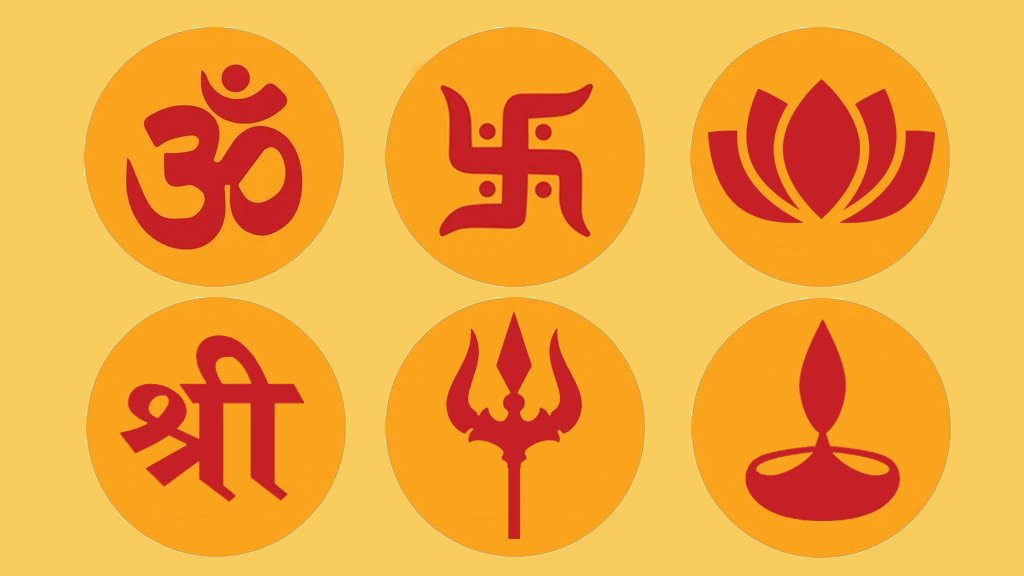
Sacred Symbols in Hinduism
Sacred geometry and symbols play a major role in Sanatan Dharma. Sanatan Dharma encompasses a bouquet of beliefs but it is broadly believed that there is only one God which expresses itself in different forms and ways. This is signified by teachings of Upanishad like ‘Ekam Sad Viprah Bahuta Vadanti’ which means that the God is one and formless and is beyond the boundaries of understanding. Thus, God manifests in many forms and also affiliated to these many forms are sacred and auspicious symbols and geometries. These symbols play a great philosophical role in the Hindu religion and are given much significance. Many of these sacred symbols are associated with various Gods and Goddesses; other times they are auspicious geometries with profound spiritual meanings. The sacred symbols play the role of abstract representation of Divinity. These symbols work as bridge between the formless god and the limited human mind. Devotees find it much convenient if the God can be correlated to symbol, which can be interacted in daily lives.
One amazing thing about these auspicious symbols in Hinduism is that they are not only used in worship and holy rituals. They also have great scientific and spiritual importance. There is a broad scope of symbolism that involves physical gestures like offering prayers with folded hands (Pranam). Such gestures usually induce the right mood and awareness for the individual. There are numerous auspicious symbols in Hinduism which symbolizes the notion of inner purity. These sacred symbols are displayed at temples and homes to bring good fortune, invite positivity and keep away all sought if negativities. Here, we have listed some of the most sacred and auspicious symbols used in Hinduism, their meaning and also the significance they hold.
Om / Aum
Om is the primary, most sacred spiritual symbol in Hinduism. Om is the root mantra and the primal sound from which all creations originated. It consists of the three Sanskrit letters aa, au, and maa which together form the sound Om or Aum. The most significant symbol in Hinduism, it appears in all prayers and is the first part of most Deities' invocations. Om is the Hindu symbol for devotion, can be found at the top of letters, pendants, Hindu and family temples. There are very few rituals of worship without this mystic sound. Om is a part of the Archanas performed at Hindu temples after every mantra uttered. Om is also where the Holy Vedas begin. In Sanatan Dharma, Om is the ‘cosmic sound’, or the ‘mystical syllable’, or the ‘affirmation to Divine’. Om is also one of the popular mantras for meditation. The English terms ‘omniscience’, ‘omnipotent’ and ‘omnipresent’ which are associated with the Supreme God are examples of words that contain the syllable Om. It is therefore also used to denote authority and Divinity.
Swastika
Swastika is considered one of the most auspicious symbols in Hinduism. The word Swastika comes from Sanskrit which means ‘lucky or auspicious thing’. Use of Swastika symbol dates back 2nd Century BC. Swastika appears like an equilateral cross and its four legs bent at 90 degrees. This symbol is sacred not only in Hinduism but also in Buddhism and Jainism. As a symbol of luck and auspiciousness, the Swastika signifies "It is well." This ancient sun's sign's right-angled arms represent the indirect method of intuition rather than intellect by which divinity is understood.
Ghanti (Bell)
Ghanti or Ghanta is a ceremonial bell used in ritual puja that involves all senses, particularly hearing. Its ringing invokes the Gods, excites the inner ear, and reminds us that the universe, like sound, can be seen but not possessed. The bell is often made from brass and has a clapper. When the bell is rung, it emits a high-pitched sound. The ringing of a bell calls the gods while simultaneously stimulating the inner ear. Hindu temples typically have a single metal bell hanging at the entryway, which visitors ring when entering the temple. During the Puja, both priests and worshipers clang bells.
Shivalinga
Shivlinga is regarded as a particularly sacred emblem, representing Lord Shiva himself, according to tradition. Nearly all of the temples devoted to Lord Shiva have the Shivlinga. Hindu legend states that Lord Shiva himself took on the shape of a Linga so that his followers may worship Him. This is due to the fact that, while being formless and imperceptible to the unaided eye, Lord Shiva is present both on earth and in heaven. Shivling is conical at the top and broad in the middle. This is how flame takes shape. The God of Shaivite philosophy is formless. God took the appearance of a flame because of the souls' grace, which allowed them to understand God easily and experience liberation. This flame is worshipped as a stone lingam and in other forms that facilitate devotion. Shaivites regard this as more sacred than form worship. Shivlinga is a physical image of Lord Shiva and is meant to be touched, seen, and worshipped. It is guaranteed to devotees that by worshiping the Linga, they can establish a connection with Lord Shiva. Frequently depicted with the Yoni (which means womb or Prakriti) is the Shivlinga. This stands for the unity of Purush and Prakriti, or male and female, which precedes the creation of the universe.
Kalash
The Sanskrit word ‘Kalash’ means pot or pitcher. The Kalash is made from a metal that usually features a broad base and a small mouth, such as brass, copper, silver, or gold. During Hindu ceremonies, a coconut and a coronet of mango leaves are placed on a pot of water. The coconut is wrapped in red thread or linen, and the coronet of mango leaves is arranged so that the tips of the leaves come into contact with the water in the Kalasha. In all Hindu celebrations and events of marriage and childbirth, Kalasha is revered. The coconut is a symbol of affluence and a cash crop. The pot's water symbolizes nature's capacity to sustain life. The state of Andhra Pradesh has adopted the Kalash as its official state emblem.
Cow or Gau Mata
The cow or Gau mata is highly revered and honored and regarded as a sacred animal in Hinduism. Even though cows are not worshipped by Hindus, they are revered in practically all of India. While practically every animal is considered sacred in Hinduism, cows are held in higher regard than other animals. The cow produces butter, ghee, yogurt, and cheese in addition to milk and cream. It is said that cow milk refines a person. Cow manure is utilized in homes as a cleanser, fuel, and fertilizer. The cow is comparable to Mother Earth, the nourisher, the selfless giver, because of the abovementioned characteristics.
The Sri Symbol
The Sanskrit word ‘Sri’ is commonly used to address people in a respectful manner. In Hinduism, the title Sri is often used to symbolize Maa Laxmi and also to honor deities. Sri can also be written as Shree or Shri. When Sri is used without any other words, it alludes to the highest consciousness. For numerous Gods and Goddesses, like Sri Ganesh, Sri Lakshmi, and Sri Vishnu, Hindus apply the prefix Sri. The term Sri appears at the start of most Hindu mantras or in between mantra lines. Spiritual leaders in Hinduism use Sri followed by 108 or 1008.
Shankha or Conch
The Shankha is a revered Hindu symbol related to Lord Vishnu. According to Hindu scripture, the Shankha bestows fame, longevity, and fortune. The Shankha was used in ancient times to begin and end gatherings such as war, trips, and meetings. Shankha generated a sound known as Shankanad. Shankha is now blown during religious ceremonies in Hindu temples and homes. It is also used during Aarti to offer light to the deities. Shankha is often used to bathe deities, particularly Lord Vishnu.
Trishul
Trishul is Lord Shiva's trident, which is also borne by other Hindu gods, sages, and saints. Trishula's three prongs depict the Trinity (Brahma, Vishnu, and Mahesh) and The Three Modes of Nature: Creation, Maintenance, and Destruction. It also symbolized the three Kalas (past, present, and future) The Three Gunas (Sattva, Rajas, and Tamas), Three Powers (will, action, and wisdom), and Three Miseries (physical, mental, and spiritual). As the trident is wielded by the Goddess Shakti, her followers hold it in high regard and consider it as an important symbol of their devotion towards her.
Rudraksha
Rudra, which means "Lord Shiva," and Ak?a, which means "Teardrops," combine to form the Sanskrit term for "rudraksha." Rudraksha is a representation of Lord Siva's tears poured in response to human suffering. Hindus wear the Rudraksha seeds strung together as a garland. It's thought that using 108 plus one beads is the proper amount. "The Guru Bead" is the name of the additional bead. Rudraksha is best worn without the use of metal since it is never polished or cut like a gemstone.
Nandi
Lord Shiva rides the Nandi bull, who serves as both the deity Parvati's gatekeeper and his mount. Nandi is a Sanskrit term meaning ‘one who brings joy’. Nandi Bull is portrayed as a seated statue in temples devoted to Lord Shiva. In Hinduism, it's important to first obtain Nandi's blessings before worshiping Lord Shiva. In India, there are numerous temples devoted just to Nandi Bull.
Peacock feather
Lord Kartikeya, also known as Murugan in South India, rides a peacock. Lord Shiva is the father of Lord Kartikeya. The dancing peacock's display represents religion in all its splendor. According to Hindu mythology, Garuda is another mythological bird that carries Lord Vishnu, and it is thought that one of its feathers was used to create the peacock. India's national bird is the peacock. Being an agriculturally dependent nation, India depends heavily on rain, which the peacock predicts by dancing and opening all of its feathers. In Hinduism, Peacock Feathers, also known as Moonkh, are considered fortunate symbols. It is believed that having peacock feathers around the house can bring prosperity and good luck. The eighth avatar of Lord Vishnu, Lord Krishna also wore a peacock feather on his crown. Students also keeps a peacock feathers in their books, believing that the Goddess of Knowledge, Maa Saraswati, will assist them in achieving academic success.
Nataraja
Lord Shiva is being represented as the cosmic dancer in the Nataraja, which means "King of Dance." It is believed that Lord Shiva begins the process of creating a new cosmos by destroying the old one with his heavenly dance, known as the Tandava. There are two different types of tandavas which is the joyful one, also known as the Ananda tandava. The dance form Rudra Tandava is performed in a furious manner. Natraj is the main god worshipped in the popular Thillai Nataraja Temple in Chidambaram.
Lotus Flower
Padma is another auspicious symbol in Hinduism which often also called the Lotus Flower. In Hinduism, Lord Vishnu, Lord Brahma, Goddess Saraswati, and Goddess Lakshmi is worshipped by Padma. The Padma symbolizes beauty and purity regardless of the favorable or unfavorable conditions in which it flourishes. It basically remains as a reminder that goodness and wealth can flourish without being affected by evil in one's surrounding. Many people refer to Lord Vishnu as the "Lotus-Eyed One."
Shatkona
Shatkona which also means "six" is a sacred Hindu symbol made up of interlocked triangles. These two triangles symbolize Lord Shiva (masculine) and Goddess Parvati (feminine). The highest three edges represent Lord Siva, Purusha, and fire. The three lower edges symbolize Shakti, Prakriti, and Water. The upward-pointing triangle represents Purusha, the Supreme Being, while the downward-pointing triangle represents Prak?ti, or Mother Nature.
Kamandal
The Kamandal is a water pot with a handle that is made from metal, clay, or coconut shells. The Hindu Sages used to carry the Kamandal, which stands for a straightforward, independent existence. The water of the kamandal is a representation of riches, life, and fertility. The Kamandal is commonly seen in the hands of ascetic Hindu gods.
Sudarshana Chakra
Lord Vishnu holds a disk-shaped weapon that is known as the Sudarshana Chakra, which has 108 razor-sharp edges. The meaning of the terms Sudarshana and Chakra are respectively "vision which is auspicious" and "the one which is mobile." Legends states that the Sudarshana Chakra is both the most powerful and the only weapon that can move. The ultimate goal of the Sudarshana Chakra is to destroy the opponent. During Homas, or Hawans, Hindus typically worship Sudarshana to fend off evil spirits or vibrations. In India, Sudarshana Chakra is revered as the primary deity in numerous temples.
Dhwaja / Saffron Flag
In Hinduism, the Saffron Flag stands for the Hindu culture, or "Sanatana Dharma." Wealth, Dharma, Advancement, Glory, wisdom, and detachment are all represented by the flag. Hinduism's flag is orange because its fundamental belief is that fire is the ultimate cleanser. The Dhwaja flag has a triangular shape as opposed to the typical rectangular flags. Hindu sages traveled from one ashram to another in the past, and they always brought fire with them. The saffron flag sign may have originated from the hardship of carrying a burning thing. Along with being seen during religious processions and festivals, the Saffron Flag can also be seen waving on the majority of Hindu temples.