Arishadvarga - Six Enemies of the Mind
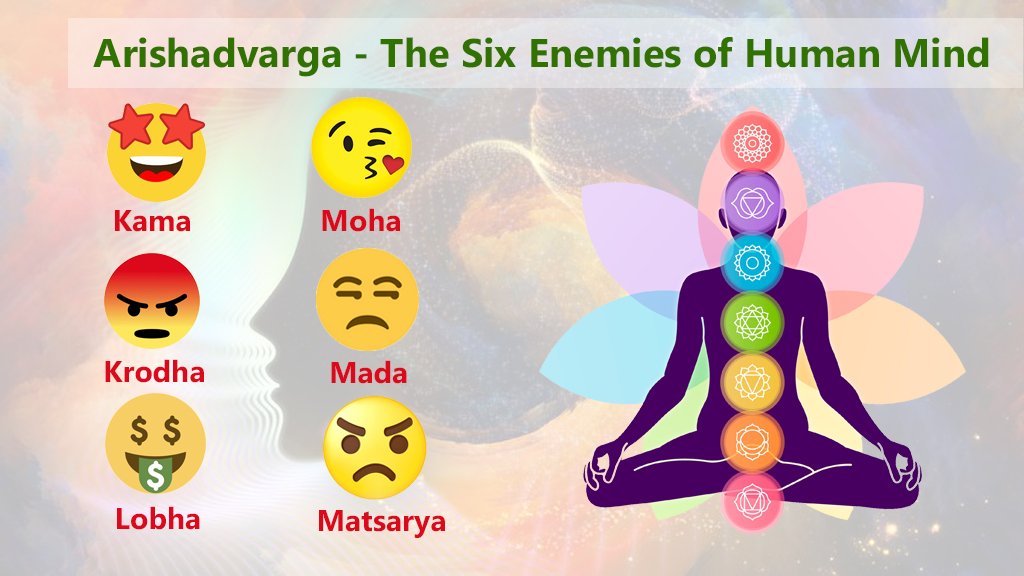
Arishadvarga, in Sanatan philosophy are regarded as six enemies of a person. Arishadvargas, also known as Shadripu are six negative traits or characteristics that a person must overcome in his life in order to attain both material and spiritual growth and progress. These six enemies of the mind detailed in scriptures are kama (lust), krodha (anger), lobha (greed), moha (delusion), mada (arrogance) and matsarya (jealousy). Each one of the six Arishadvarga has the capacity to pull and keep a person down. On the other hand, an individual who overcomes the Arishadvargas harnesses both spiritual and material growth. As per ancient Vedic sages (Rishis), only a person who has overcome the Arishadvargas may be referred to as wise and knowledgeable.
It is stated in scriptures that one cannot be regarded as wise, mature or knowledgeable unless he has overcome the six internal adversaries, regardless of how powerful, wealthy, successful one may look on the outside. In Sanatana Dharma, overcoming the six foes known is essential for inner peace, bliss and happiness. In Srimad Bhagwad Gita, Lord Krishna states, ‘One should uplift oneself by oneself; one should not degrade oneself. Indeed, the mind alone is the friend of oneself and mind alone is one’s enemy’. Thus, the mind which has overcome Arishadvargas is a friend, whereas a mind which hasn’t yet overcome the Arishadvargas is a foe or enemy of self.
The Upanishads mentions that ‘Human bondage and liberation (moksha) are solely the result of the mind’. A mind immersed in senses and sensatory pleasures results in bondage, and detachment from them leads to true freedom. It is all but understood that an external enemy cannot do as much damage as one's own thoughts can. While one can defend oneself against the physical or emotional harm that others may inflict upon them, but it can be difficult to defend oneself against one's own negative attitudes, thoughts and feelings.
The Arishadvargas are in some way connected to each other, but each one of them also work independently. For instance, one cannot be jealous and be entirely free of anger at the same time, as jealousy always leads towards anger directed at our perceived adversary. Another instance is how excessive greed for money which in itself is one of the Arishadvargas can lead to sense of pride or ego when one becomes wealthy. As per Vedic scriptures all six of the Arishadvarga have a negative impact on a person but the first three are described as ‘road to hell’.
What are the Arishadvarga
The Arishadvargas or the six detrimental enemies of the mind as mentioned in the Vedic Scriptures are:
Kama (Desires)
Kama is mostly associated with lust but here Kama basically means ‘desires’ and not merely lust. Kama refers to burning desires of senses including that to carnal pleasure. All beings naturally have desire in one form or another, but when these desires are not controlled by the principles of righteousness and are without the required checks and balances, they become a negative trait. Any desire that compromises on moral, social or economic foundation of self or family or society, no matter how small it is, is termed as Adharma or something that goes against Dharma. Thus Kama is therefore best characterized in this situation as craving something which is contrary to Dharma. Selfish desires cause people to act wrongly, which results in bad karma having catastrophic long-term effects.
Krodha (Anger)
Krodha meaning anger is described as temporary madness. Anger leads to irritation and unpredictable behavior, many a times leading to violence. When the self in angry, the mind becomes unstable, it leads to stress for oneself and others. The resulting behavior is unhelpful and even harmful to say the least. Krodha can be a reaction to a situation or a by-product of other negative traits such as jealousy or non-fulfillment of desires or a standalone issue of the mind. In either cases anger is a negative emotion or trait that inadvertently jeopardize one’s own spiritual journey, long-term interests and wellbeing.
Lobha (Greed)
Greed is often the result of unjust or excessive desires. Undoubtedly, all living being have some primary requirements, such as the need to eat, sleep, survive, and reproduce. However, it is stated that needs are easily met, whereas greed never goes away. When one’s needs interfere or transgresses in to the needs of others, they can be regarded as greed. When in a person the dominant mental state is that of accumulation of ‘more’ or the need to have what others have, such mind can never achieve peace or happiness. Only when there is a genuine ability to distinguish between necessity and greed can there be peace, calmness, wisdom and serenity.
Moha (Delusion)
Moha can be described as delusion, attachment or infatuation. It is a state of being that leads to a confused mind, clouds mental clarity and ability to make judgment decision free from prejudices. Moha arises when the mind becomes overly attached to people, possessions, power, or sensory pleasures, leading to distorted thinking and ignorance of truth. Moha binds the soul to the material world, making it difficult to perceive reality as it is. It often manifests as emotional dependence, blind love, or obsession, causing one to overlook flaws and act irrationally. In the spiritual path, Moha is seen as a major obstacle because it keeps the mind restless and distracted from self-realization. Scriptures teach that overcoming Moha requires cultivating wisdom, detachment and devotion to the Divine. By recognizing the temporary nature of worldly attachments, one can break free from Moha and progress toward spiritual growth, inner clarity and peace.
Mada (Arrogance)
Mada means arrogance or pride, it is often equated with having an inflated ego and ‘I, me, myself’ mentality. A mind suffering from Mada has a false sense of superiority, which leads to arrogance and often ignorance. It is believed that the mental state of an individual obscured in Mada is equivalent to someone who is intoxicated with alcohol or any other narcotic drug. Arrogance can lead the mind to behave irrationally and controlling in the process hurting others and self. Both growth of spiritual self and that of relations are hampered. Arrogance and pride often leads to anger, as a result, one makes enemies and loses respect and peace of mind.
Matsarya (Jealousy)
Matsarya can be described as jealousy or envy. It stems from ego, insecurity and comparison where one cannot tolerate the happiness or prosperity of others. Matsarya not only damages relationships but also erodes inner peace, as the mind constantly dwells on what others have rather than appreciating one’s own blessings. This negative emotion blinds a person to their strengths, pushing them into unhealthy competition and resentment. In spiritual teachings, Matsarya is considered a great barrier to growth because it fills the heart with bitterness instead of compassion. Overcoming Matsarya requires cultivating contentment, gratitude and self-awareness. Letting go of Matsarya leads to a calmer mind, healthier relationships, and progress on the path to spiritual progress.
Many a time knowledge and intellect are thought to be akin with wisdom, but the said is not always the case. Wisdom fosters inner contentment, peace of mind and calm. To be considered wise, one must have overcome the Arishadvargas. As per scriptures it is believed that overcoming all the six Arishadvargas is utmost important as even one of the six can harm spiritual growth and progress. Any individual who has overcome the Arishadvargas goes far in his spiritual journey, uplifts himself and others and wields true wisdom and knowledge.
Related posts
Panchmahabhootas (Five Elements) in Vastu Shastra
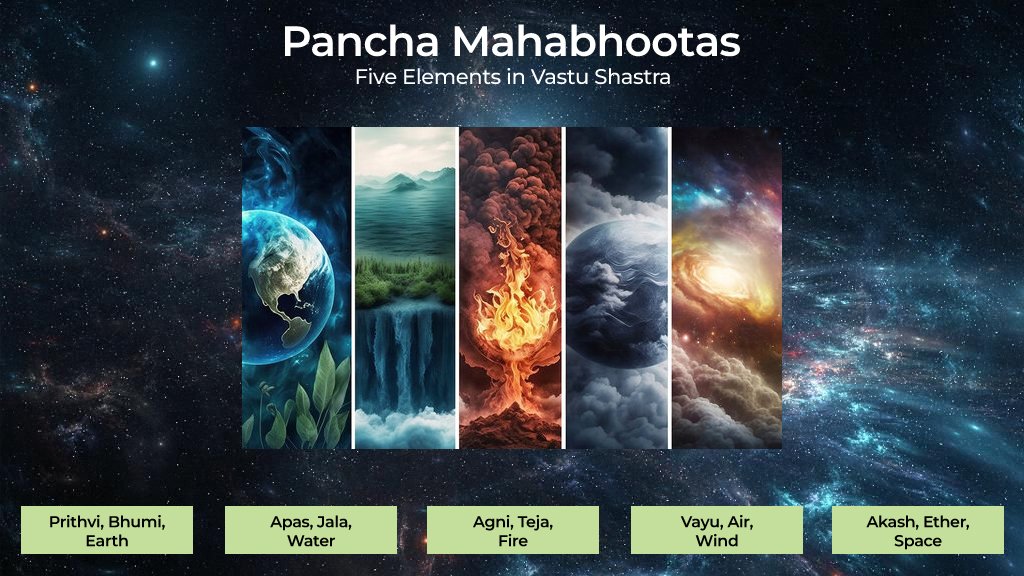
Panchmahabhoota can be loosely translated as ‘five great elements’. They refer to as five elements or five fundamental building blocks of nature or the material universe. The Panchmahabhoota are Air (Vayu), Water (Jal), Fire (Agni), Earth (Prithvi) and Space (Aakash). According to ancient Vedic wisdom, all living and non-living things are made from these five elements in varying proportions, and balance among them is essential for health, harmony and cosmic order. The concept of Panchmahabhoota or Panchtatva is widely used in Ayurveda, Yoga and Vastu Shastra. The Vastu Shastra is the ancient science of architecture and construction. The science dates back to more than 5000 years and primarily focuses on the principle of harmony, balance and alignment with the nature. As per Vastu Shastra, everything in the Universe including the human body is composed of five elements which are known as Panch Mahabhootas or the Panchtattva.
All creation in the Universe, be it planets or stars or any type of life form has a profound connection with the five elements. Each of the five elements has an important and distinct quality which is stability (earth), fluidity (Jal), transformation (fire), movement (air) and expansiveness (space). The balance of the 5 elements within the body and outside environment is considered essential for health, harmony and growth. The five elements are also connected with our five senses. Vastu Shastra states that all the Panchmahabhootas are constantly and intrinsically interrelated. Thus it is of utmost importance that during construction or designing balance of the Panchtatva with respect of various directions are understood and given ample thought. Complying with the principals of Vastu Shastra will ensure balance, positivity, good health and good fortune in the dwelling. On the other hand construction against the principals of Vastu will cause negativity, discord and disharmony.
Space (Akash)
Akash or space is the first element amongst the Panchmahabhootas. We all know the unique qualities of the space element which are expansion, vastness and void. The entire universe including us exists in this celestial empty space. The remaining four elements strategically and skillfully exist and interact in this first element. In Vastu Shastra, the Brahamsthana or the center of the construction and west direction is associated with the space element. The Akash element represents expansion of consciousness, clarity, growth, progress and connection to the infinite. A balanced space element fosters openness, creativity, and inner peace, while imbalance can lead to feelings of emptiness or isolation. One may maximize benefits of the space element by creating or maintaining adequate open spaces and keeping the dwelling clutter free promoting peace and tranquility. From space elements comes the second element which is Vayu (Air).
Air (Vayu)
The Vayu or the air element is the second amongst the Panchmahabhootas. The unique qualities of the Vayu element are movement, creativity, communication, flow, sense of touch and sound. After space element, air the second most important element in nature. Air element is associated with East and East-North-East directions. Thus in Vastu Shastra it is recommended to keep the said directions properly ventilated and airy. This ensures good health and overall wellbeing. The vayu element is also associated with joy, refreshment, fun, pleasure, happiness. But the most vital association of the Vayu element is that of life, growth and creativity. Blockages and imbalances for the Vayu element cause stress and mental agony for the residents of a dwelling. From the Vayu element comes the Fire or Agni Tatva.
Fire (Agni)
Fire of the Agni tatva is considered as the element of transformation and energy. The two primary features of this element are, heat and light. The unique qualities of the Agni element are energy, passion and transformation. The directions associated with the element are South-East and South directions. The fire elements is often related with the Sun, just like the vayu elements it is impossible for any life form to exist on earth without the energy of heat and light from the sun. Fire element is the first element that displays qualities such as color, shape, size and more. Fire element is associated with transformation of day to night, and also change of seasons. In Vastu Shastra balanced fire elements blesses residents of a dwelling with vigor, zeal, confidence, passion, name, fame and power. From the Fire element comes the Jal or water Tatva.
Water (Jal)
Among the Panch Mahabhootas, Jal or water element is the scarcest element. The North and the Northeast directions are associated with the water element. The unique qualities of the water element are touch, sound, shape and taste. Water can take all three forms namely liquid (water form), ice (solid form) and vapor (gas form). Water has a tendency to flow downward and also change shape in response to temperature changes. In its purest state, water has no taste, smell or color. Water is one of the most important elements for all living beings on the earth. Like earth has around 70 % water, the human body too shares the same percentage. New ideas, purity of thoughts and free flow of thoughts are connected with water element. It is also connected with healing energies, immunity and spirituality. Water is related to cleansing and purification.
Earth (Prithvi)
Earth or Prithvi element is considered as an element of support, stability and nourishment. The South-West direction is associated with the earth element. The unique qualities of the earth element are stability, strength, ground and that of having a specified shape and size. It forms the solid structure of the physical world and our bodies namely the bones, muscles, tissues, and the ground we walk on. Spiritually, the earth element fosters patience, resilience, and a sense of security, it also connects us to the roots of our existence. A balanced earth element brings strength, stability, and well-being, while imbalance can lead to lethargy, stubbornness, or insecurity.
In Vastu Shastra, the Panchmahabhootas or the five elements play a vital role in creating harmonious and balanced dwellings. With correct balance, alignment and usage of these elements or tattvas, one can attract serenity, happiness, prosperity and good health.
Vedic Astrology for Wealth and Prosperity
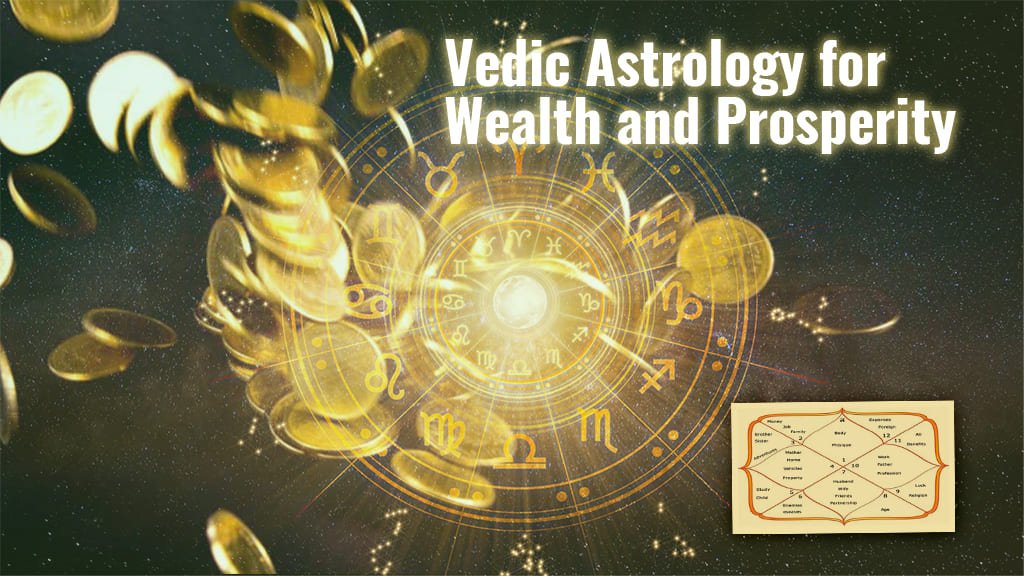
A person's birth chart, also referred to as their horoscope or natal chart, is a map showing the positions of the Navgraha (9 Planets) at the moment of their birth. According to popular belief, a person's personality, inclinations, strengths, weaknesses and life events are exhibited and can be known from their birth chart's planetary positions. There are twelve houses in the birth chart, each of which stands for an individual component of the individual's life. The first house, for instance, is symbolic of the individual, the second of wealth and belongings, the fourth of home and family, and so forth. The positions of the planets in each house can reveal more details about a person's past, present and future. By studying the birth chart of an individual various aspects and facets of his life can be known, like his temperament, nature, health, career and also his potential for attracting and acquiring wealth and prosperity. To know more about a person’s financial standing it is vital to check the placement of various Planets which bless a native with the blessings of wealth and prosperity.
Planets in Vedic Astrology That Signify Wealth
Although in Vedic astrology most of the nine Planets are someway related to wealth and financial prosperity but some Planets namely Venus, Rahu, Mercury and the Moon are directly and closely related to blessings of money, wealth and financial prosperity.
Planet Venus (Shukra Graha)
Planet Venus is known as the planet of luxury, love and beauty. It is also linked to material wealth and worldly goods. Its position in the birth chart might reveal information about a person's capacity to attract wealth and material growth. Venus represents material wealth, financial success, and the capacity to appreciate finer things in life when it is strongly placed in an individual's birth chart. In roman mythology, Venus is a goddess of pleasure, elegance and beauty. As such, the energy of strong Venus can draw in prosperity and financial progress.
Planet Rahu
Rahu is regarded as one of the shadow planets in Vedic astrology and is linked to worldly achievement and materialistic aspirations. Although Rahu isn't usually thought of as a planet that specifically signifies wealth, its position and effects in a person's birth chart can have an effect on their ability to make money. The characteristics of desire, creativity, and taking chances that are connected with Rahu might be beneficial while aiming for financial success. Rahu, however, can also be a sign of a propensity for materialism, greed, and impulsive decisions, all of which can be harmful to wealth.
Rahu's position in a person's birth chart can suggest areas of concentration or chances for prosperity in money. For instance, Rahu in the second house, which is linked to wealth and belongings, can suggest that an individual has a great desire to succeed financially and may be able to do so by using unusual strategies or taking risks. Rahu's placement in the 11th house, which is related to gains and income, might also suggest a person's capacity for making money through unorthodox methods, like technology or entrepreneurship.
Planet Jupiter (Brahaspati Graha)
Planet Jupiter is regarded as the Planet of wisdom and knowledge. In Vedic astrology, Planet Jupiter (Guru) is regarded as the most benevolent and auspicious planet, often called the karaka (significator) of wealth, wisdom, and prosperity. Jupiter represents expansion, abundance, and divine blessings. When strongly in a birth chart it bestows financial stability and long-term prosperity. Planet Jupiter governs knowledge and good karma, which are key drivers for attracting sustainable wealth. A strong Jupiter enhances one’s judgment and optimism which are traits that naturally lead to material progress and abundance.
Planet Mercury (Buddh Graha)
Planet Mercury is regarded as a planet of communication and finance in addition to being the planet of intelligence and wisdom. Its position in the birth chart might reveal information about a person's financial potential and capacity for sound financial judgment. A strongly placed Mercury can be a sign of financial success, expertise in finance, and the capacity to make prudent financial judgments. The influence and energy of Planet Mercury can attract profound chances for prosperity and financial progress.
Planet Moon (Chandra Graha)
The Moon is also known as the planet of emotions and prosperity in the material world. It is the planet of intuition and support. Its position in the birth chart can reveal information about a person's capacity for attracting wealth and their potential for financial success. A good position of the Moon in the birth chart can suggest financial success, stability and the capacity to attract wealth into one's life. The Moon can draw chances for success and financial gain because it is connected to emotions, intuition and nurturing.
Planetary Combinations for Wealth and Prosperity
When an individual has one or more Planets which are associated with wealth and financial prosperity favorably placed in his birth chart it improves the chances of him to attract opportunities to make money. When an auspicious conjunction or combination of Planets related to finance are formed known as Yog it leads to blessings financial success and prosperity. Yogas such as Raj Yog, Gaj Kesari Yog and Laxmi Yog and others can lead to financial growth. Even individual placement of benefic Planets such as that of Jupiter and Venus or Mercury and Moon can enhance an individual’s potential to attract and accumulate wealth and prosperity. But it's important to understand that a person's financial growth is not only due to mere positions of the planets in their birth chart but due to a variety of factors such as Karma, effort, perseverance, planning and more.
Financial Success through Vedic Astrology
Even while Vedic astrology can shed light on a person's financial prospects, it's crucial to apply this knowledge as a means of personal development. A person may work toward realizing their financial potential and building a prosperous future by comprehending the strengths and weaknesses stated in their birth chart. Consulting with a skilled astrologer can be the first step to use Vedic astrology as a tool for financial success. A person's financial potential can be ascertained by analyzing their birth chart, and an astrologer can also provide guidance on how to optimize finances. Based on planetary transits, they can also offer advice on when it's best to make investments and take financial decisions.
Developing self-awareness and self-reflection is another approach to apply Vedic astrology for financial success. A person can strive toward realizing their financial potential and building a prosperous future by analyzing their own strengths and limitations as shown by their birth chart. A person may profit by pursuing economic endeavors or investments that are in line with their own principles and views. Based on the position of the planets in a person's birth chart, Vedic astrology can provide insights into their potential for prosperity and wealth. In Vedic astrology, the planets Venus, Mercury, Moon and also Jupiter are thought to represent wealth. Nonetheless, it is crucial to remember that a person's financial success is influenced by a variety of factors, including hard effort, perseverance, and sound financial planning. The positioning of planets in the birth chart is simply one of the factors.
Developing self-awareness and self-reflection is another approach to apply Vedic astrology for financial success. A person can strive toward realizing their financial potential and building a prosperous future by analyzing their own strengths and limitations as shown by their birth chart. A person may profit by pursuing economic endeavors or investments that are in line with their own principles and views. Based on the position of the planets in a person's birth chart, Vedic astrology can provide insights into their potential for prosperity and wealth. In Vedic astrology, the planets Venus, Mercury, Moon and also Jupiter are thought to represent wealth. Nonetheless, it is crucial to remember that a person's financial success is influenced by a variety of factors, including hard effort, perseverance, and sound financial planning. The positioning of planets in the birth chart is simply one of the factors.
Remedies to Attract Wealth and Prosperity
In Vedic Astrology, there are simple remedies and rituals that can be used to appease Navgraha and seek blessings of wealth and prosperity. Some of these remedies and rituals to attract wealth and good fortune are mentioned below:
1. Mantra recitation of Goddess Laxmi, Lord Kuber and Navagraha along with their Puja and Hawan
2. Donation to poor, needy, animals especially cows help attract positivity, auspiciousness and good fortune
3. Place and Worship Sri Yantra on your Puja Altar
4. Keep your home and office clean, organized and clutter-free
5. Remove water leakages and broken clocks and watches from home
6. Strengthen required Planets by wearing appropriate gemstone and Rudraksha
To get a complete picture of an individual's financial and wealth potential, it is necessary to examine the kundli as a whole, taking into account the placements of the planets, houses, and their relationships. The signs of wealth in a person's financial life can also be significantly affected by other elements including initiative on their part, timing, placement of other planets and more.
Category