Vedic Astrology for Wealth and Prosperity
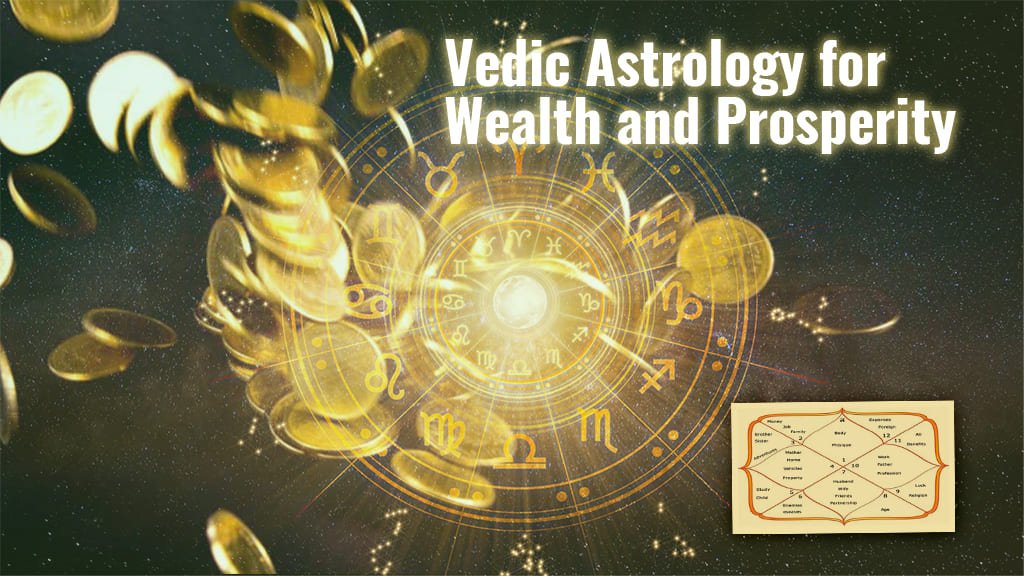
A person's birth chart, also referred to as their horoscope or natal chart, is a map showing the positions of the Navgraha (9 Planets) at the moment of their birth. According to popular belief, a person's personality, inclinations, strengths, weaknesses and life events are exhibited and can be known from their birth chart's planetary positions. There are twelve houses in the birth chart, each of which stands for an individual component of the individual's life. The first house, for instance, is symbolic of the individual, the second of wealth and belongings, the fourth of home and family, and so forth. The positions of the planets in each house can reveal more details about a person's past, present and future. By studying the birth chart of an individual various aspects and facets of his life can be known, like his temperament, nature, health, career and also his potential for attracting and acquiring wealth and prosperity. To know more about a person’s financial standing it is vital to check the placement of various Planets which bless a native with the blessings of wealth and prosperity.
Planets in Vedic Astrology That Signify Wealth
Although in Vedic astrology most of the nine Planets are someway related to wealth and financial prosperity but some Planets namely Venus, Rahu, Mercury and the Moon are directly and closely related to blessings of money, wealth and financial prosperity.
Planet Venus (Shukra Graha)
Planet Venus is known as the planet of luxury, love and beauty. It is also linked to material wealth and worldly goods. Its position in the birth chart might reveal information about a person's capacity to attract wealth and material growth. Venus represents material wealth, financial success, and the capacity to appreciate finer things in life when it is strongly placed in an individual's birth chart. In roman mythology, Venus is a goddess of pleasure, elegance and beauty. As such, the energy of strong Venus can draw in prosperity and financial progress.
Planet Rahu
Rahu is regarded as one of the shadow planets in Vedic astrology and is linked to worldly achievement and materialistic aspirations. Although Rahu isn't usually thought of as a planet that specifically signifies wealth, its position and effects in a person's birth chart can have an effect on their ability to make money. The characteristics of desire, creativity, and taking chances that are connected with Rahu might be beneficial while aiming for financial success. Rahu, however, can also be a sign of a propensity for materialism, greed, and impulsive decisions, all of which can be harmful to wealth.
Rahu's position in a person's birth chart can suggest areas of concentration or chances for prosperity in money. For instance, Rahu in the second house, which is linked to wealth and belongings, can suggest that an individual has a great desire to succeed financially and may be able to do so by using unusual strategies or taking risks. Rahu's placement in the 11th house, which is related to gains and income, might also suggest a person's capacity for making money through unorthodox methods, like technology or entrepreneurship.
Planet Jupiter (Brahaspati Graha)
Planet Jupiter is regarded as the Planet of wisdom and knowledge. In Vedic astrology, Planet Jupiter (Guru) is regarded as the most benevolent and auspicious planet, often called the karaka (significator) of wealth, wisdom, and prosperity. Jupiter represents expansion, abundance, and divine blessings. When strongly in a birth chart it bestows financial stability and long-term prosperity. Planet Jupiter governs knowledge and good karma, which are key drivers for attracting sustainable wealth. A strong Jupiter enhances one’s judgment and optimism which are traits that naturally lead to material progress and abundance.
Planet Mercury (Buddh Graha)
Planet Mercury is regarded as a planet of communication and finance in addition to being the planet of intelligence and wisdom. Its position in the birth chart might reveal information about a person's financial potential and capacity for sound financial judgment. A strongly placed Mercury can be a sign of financial success, expertise in finance, and the capacity to make prudent financial judgments. The influence and energy of Planet Mercury can attract profound chances for prosperity and financial progress.
Planet Moon (Chandra Graha)
The Moon is also known as the planet of emotions and prosperity in the material world. It is the planet of intuition and support. Its position in the birth chart can reveal information about a person's capacity for attracting wealth and their potential for financial success. A good position of the Moon in the birth chart can suggest financial success, stability and the capacity to attract wealth into one's life. The Moon can draw chances for success and financial gain because it is connected to emotions, intuition and nurturing.
Planetary Combinations for Wealth and Prosperity
When an individual has one or more Planets which are associated with wealth and financial prosperity favorably placed in his birth chart it improves the chances of him to attract opportunities to make money. When an auspicious conjunction or combination of Planets related to finance are formed known as Yog it leads to blessings financial success and prosperity. Yogas such as Raj Yog, Gaj Kesari Yog and Laxmi Yog and others can lead to financial growth. Even individual placement of benefic Planets such as that of Jupiter and Venus or Mercury and Moon can enhance an individual’s potential to attract and accumulate wealth and prosperity. But it's important to understand that a person's financial growth is not only due to mere positions of the planets in their birth chart but due to a variety of factors such as Karma, effort, perseverance, planning and more.
Financial Success through Vedic Astrology
Even while Vedic astrology can shed light on a person's financial prospects, it's crucial to apply this knowledge as a means of personal development. A person may work toward realizing their financial potential and building a prosperous future by comprehending the strengths and weaknesses stated in their birth chart. Consulting with a skilled astrologer can be the first step to use Vedic astrology as a tool for financial success. A person's financial potential can be ascertained by analyzing their birth chart, and an astrologer can also provide guidance on how to optimize finances. Based on planetary transits, they can also offer advice on when it's best to make investments and take financial decisions.
Developing self-awareness and self-reflection is another approach to apply Vedic astrology for financial success. A person can strive toward realizing their financial potential and building a prosperous future by analyzing their own strengths and limitations as shown by their birth chart. A person may profit by pursuing economic endeavors or investments that are in line with their own principles and views. Based on the position of the planets in a person's birth chart, Vedic astrology can provide insights into their potential for prosperity and wealth. In Vedic astrology, the planets Venus, Mercury, Moon and also Jupiter are thought to represent wealth. Nonetheless, it is crucial to remember that a person's financial success is influenced by a variety of factors, including hard effort, perseverance, and sound financial planning. The positioning of planets in the birth chart is simply one of the factors.
Developing self-awareness and self-reflection is another approach to apply Vedic astrology for financial success. A person can strive toward realizing their financial potential and building a prosperous future by analyzing their own strengths and limitations as shown by their birth chart. A person may profit by pursuing economic endeavors or investments that are in line with their own principles and views. Based on the position of the planets in a person's birth chart, Vedic astrology can provide insights into their potential for prosperity and wealth. In Vedic astrology, the planets Venus, Mercury, Moon and also Jupiter are thought to represent wealth. Nonetheless, it is crucial to remember that a person's financial success is influenced by a variety of factors, including hard effort, perseverance, and sound financial planning. The positioning of planets in the birth chart is simply one of the factors.
Remedies to Attract Wealth and Prosperity
In Vedic Astrology, there are simple remedies and rituals that can be used to appease Navgraha and seek blessings of wealth and prosperity. Some of these remedies and rituals to attract wealth and good fortune are mentioned below:
1. Mantra recitation of Goddess Laxmi, Lord Kuber and Navagraha along with their Puja and Hawan
2. Donation to poor, needy, animals especially cows help attract positivity, auspiciousness and good fortune
3. Place and Worship Sri Yantra on your Puja Altar
4. Keep your home and office clean, organized and clutter-free
5. Remove water leakages and broken clocks and watches from home
6. Strengthen required Planets by wearing appropriate gemstone and Rudraksha
To get a complete picture of an individual's financial and wealth potential, it is necessary to examine the kundli as a whole, taking into account the placements of the planets, houses, and their relationships. The signs of wealth in a person's financial life can also be significantly affected by other elements including initiative on their part, timing, placement of other planets and more.
Related posts
Arishadvarga - Six Enemies of the Mind
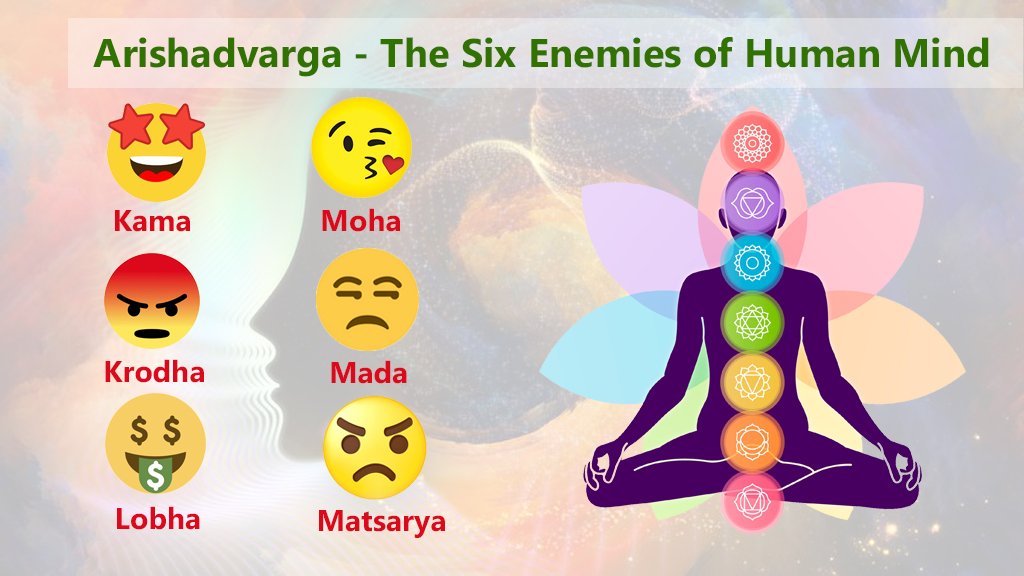
Arishadvarga, in Sanatan philosophy are regarded as six enemies of a person. Arishadvargas, also known as Shadripu are six negative traits or characteristics that a person must overcome in his life in order to attain both material and spiritual growth and progress. These six enemies of the mind detailed in scriptures are kama (lust), krodha (anger), lobha (greed), moha (delusion), mada (arrogance) and matsarya (jealousy). Each one of the six Arishadvarga has the capacity to pull and keep a person down. On the other hand, an individual who overcomes the Arishadvargas harnesses both spiritual and material growth. As per ancient Vedic sages (Rishis), only a person who has overcome the Arishadvargas may be referred to as wise and knowledgeable.
It is stated in scriptures that one cannot be regarded as wise, mature or knowledgeable unless he has overcome the six internal adversaries, regardless of how powerful, wealthy, successful one may look on the outside. In Sanatana Dharma, overcoming the six foes known is essential for inner peace, bliss and happiness. In Srimad Bhagwad Gita, Lord Krishna states, ‘One should uplift oneself by oneself; one should not degrade oneself. Indeed, the mind alone is the friend of oneself and mind alone is one’s enemy’. Thus, the mind which has overcome Arishadvargas is a friend, whereas a mind which hasn’t yet overcome the Arishadvargas is a foe or enemy of self.
The Upanishads mentions that ‘Human bondage and liberation (moksha) are solely the result of the mind’. A mind immersed in senses and sensatory pleasures results in bondage, and detachment from them leads to true freedom. It is all but understood that an external enemy cannot do as much damage as one's own thoughts can. While one can defend oneself against the physical or emotional harm that others may inflict upon them, but it can be difficult to defend oneself against one's own negative attitudes, thoughts and feelings.
The Arishadvargas are in some way connected to each other, but each one of them also work independently. For instance, one cannot be jealous and be entirely free of anger at the same time, as jealousy always leads towards anger directed at our perceived adversary. Another instance is how excessive greed for money which in itself is one of the Arishadvargas can lead to sense of pride or ego when one becomes wealthy. As per Vedic scriptures all six of the Arishadvarga have a negative impact on a person but the first three are described as ‘road to hell’.
What are the Arishadvarga
The Arishadvargas or the six detrimental enemies of the mind as mentioned in the Vedic Scriptures are:
Kama (Desires)
Kama is mostly associated with lust but here Kama basically means ‘desires’ and not merely lust. Kama refers to burning desires of senses including that to carnal pleasure. All beings naturally have desire in one form or another, but when these desires are not controlled by the principles of righteousness and are without the required checks and balances, they become a negative trait. Any desire that compromises on moral, social or economic foundation of self or family or society, no matter how small it is, is termed as Adharma or something that goes against Dharma. Thus Kama is therefore best characterized in this situation as craving something which is contrary to Dharma. Selfish desires cause people to act wrongly, which results in bad karma having catastrophic long-term effects.
Krodha (Anger)
Krodha meaning anger is described as temporary madness. Anger leads to irritation and unpredictable behavior, many a times leading to violence. When the self in angry, the mind becomes unstable, it leads to stress for oneself and others. The resulting behavior is unhelpful and even harmful to say the least. Krodha can be a reaction to a situation or a by-product of other negative traits such as jealousy or non-fulfillment of desires or a standalone issue of the mind. In either cases anger is a negative emotion or trait that inadvertently jeopardize one’s own spiritual journey, long-term interests and wellbeing.
Lobha (Greed)
Greed is often the result of unjust or excessive desires. Undoubtedly, all living being have some primary requirements, such as the need to eat, sleep, survive, and reproduce. However, it is stated that needs are easily met, whereas greed never goes away. When one’s needs interfere or transgresses in to the needs of others, they can be regarded as greed. When in a person the dominant mental state is that of accumulation of ‘more’ or the need to have what others have, such mind can never achieve peace or happiness. Only when there is a genuine ability to distinguish between necessity and greed can there be peace, calmness, wisdom and serenity.
Moha (Delusion)
Moha can be described as delusion, attachment or infatuation. It is a state of being that leads to a confused mind, clouds mental clarity and ability to make judgment decision free from prejudices. Moha arises when the mind becomes overly attached to people, possessions, power, or sensory pleasures, leading to distorted thinking and ignorance of truth. Moha binds the soul to the material world, making it difficult to perceive reality as it is. It often manifests as emotional dependence, blind love, or obsession, causing one to overlook flaws and act irrationally. In the spiritual path, Moha is seen as a major obstacle because it keeps the mind restless and distracted from self-realization. Scriptures teach that overcoming Moha requires cultivating wisdom, detachment and devotion to the Divine. By recognizing the temporary nature of worldly attachments, one can break free from Moha and progress toward spiritual growth, inner clarity and peace.
Mada (Arrogance)
Mada means arrogance or pride, it is often equated with having an inflated ego and ‘I, me, myself’ mentality. A mind suffering from Mada has a false sense of superiority, which leads to arrogance and often ignorance. It is believed that the mental state of an individual obscured in Mada is equivalent to someone who is intoxicated with alcohol or any other narcotic drug. Arrogance can lead the mind to behave irrationally and controlling in the process hurting others and self. Both growth of spiritual self and that of relations are hampered. Arrogance and pride often leads to anger, as a result, one makes enemies and loses respect and peace of mind.
Matsarya (Jealousy)
Matsarya can be described as jealousy or envy. It stems from ego, insecurity and comparison where one cannot tolerate the happiness or prosperity of others. Matsarya not only damages relationships but also erodes inner peace, as the mind constantly dwells on what others have rather than appreciating one’s own blessings. This negative emotion blinds a person to their strengths, pushing them into unhealthy competition and resentment. In spiritual teachings, Matsarya is considered a great barrier to growth because it fills the heart with bitterness instead of compassion. Overcoming Matsarya requires cultivating contentment, gratitude and self-awareness. Letting go of Matsarya leads to a calmer mind, healthier relationships, and progress on the path to spiritual progress.
Many a time knowledge and intellect are thought to be akin with wisdom, but the said is not always the case. Wisdom fosters inner contentment, peace of mind and calm. To be considered wise, one must have overcome the Arishadvargas. As per scriptures it is believed that overcoming all the six Arishadvargas is utmost important as even one of the six can harm spiritual growth and progress. Any individual who has overcome the Arishadvargas goes far in his spiritual journey, uplifts himself and others and wields true wisdom and knowledge.

16 Samskaras and their Significance
In Sanatan culture, Samskaras are rites of passage; they are rituals or ceremonies that are to be undertaken during various stages of life. They can also be termed as life events which have been devised by the learned through their wisdom, knowledge and experiences and passed on through generations. Samskara or Sanskara can be described as various rituals or customs that are to be performed to live a life in accordance with Dharma. At various stages of life and spiritual journey these Samskaras are recommended by ancient sages for purification and other benefits. Samskaras help an individual live a balanced and grounded life and become a member of the society and community. Ancient sages thousands of years ago recommended these Samskaras in Vedic scriptures such as Grihasutras and others. Sage Aswalayana recommends 11 customs, Sage Bauddhayana, Paraskar and Varaha recommend 13, Sage Vaikhana talks of 18 and Maharishi Gautam about 40 sanskaras. But the most widely accepted list of Samskaras are the 16 Samskaras that are recommended by Rishi Veda Vyas. Samskaras, also known as Sanskaras have profound physical, spiritual and emotional benefits for an individual. In Sanatan Dharma, there are sixteen primary Samskaras that are to be conducted during different stages of an individual’s life. Many a time conducting a particular Samskara signifies that a particular stage in a native’s life has begun or has ended. The word ‘Samskaras’ is a Sanskrit word which roughly means preparation or ‘getting ready’. It can also be termed as a purification process by cleansing or refinement. The 16 Samskaras in themselves encompass within themselves various physical, spiritual, mystic and Divine aspects and dimensions.
The significance and importance of undertaking the 16 Samskaras are mentioned in numerous Vedic scriptures along with the methodology of conducting them. The benefits are implication of the 16 Samskaras traverses through more than one life-time. They help one grow spiritually, learn and break the cycle of life and death (reincarnation) and ultimately achieve Moksha or liberation. Vedic scriptures mention how the Samskaras help a native free themselves from the bondages and karmic debts and propels his soul on the path of purification and spiritual enlightenment. Generally speaking, all aspects of human life are being covered by the Samaskaras. It addresses the Adhyatmik (Spiritual), Adibhautik (Physical) and Adhideivik (Divine) aspects of life. By adhering to these rituals at different stages of life, an individual can destroy negative karma and purify and cleanse themselves and grow spiritually as well as materially. Out of these 16 Samskara, 8 are primary or very important in nature and these are known as Ashtasamskaras or eight Samskaras. These eight Samskaras are Namakarana, Anna Prasana, Karnavedha, Keshanta Karma, Vidyarambha, Upanayana, Vivaha and Antyeshti.
Significance and Benefits of the 16 Samskaras
Conduction the 16 Samskaras have numerous physical and spiritual benefits, primarily it blesses one with peace of mind, stability and spiritual growth. Subconsciously, they create memories that help shape distinct positive behaviors and perspectives. Undertaking the Samskaras are in themselves accumulation of good karma, an act of purification that causes destruction of negativities and ignorance. The also help give proper perspective and direction during various stages of life especially when there is confusion or period of uncertainty or problems. As per Vedic scriptures there are a total of forty Sanskaras that are to be undertaken. Out of these forty, sixteen are considered as most pious, major or primary ones; together they are referred to as ‘Shodasha Sanskaras’. In Sanatan Dharma, life is considered as sacred and every part of it is to be celebrated. Thus the 16 Samskaras can also be termed as celebration of an individual’s journey of life through various phases, from birth to death.
What are the 16 Samskaras
Mentioned below are the sixteen Samskaras in Sanatan Dharma and their details:
1. Garbhadhana
Garbhadhana samskara is the first amongst the 16 samskaras. It is conducted when a married couple decides to start a family i.e. before conceiving a child. The word Garbhadhana is made using two words ‘Garbha’ meaning womb and ‘Adhana’ meaning receiving. The Taittiriya Upanishad stresses the importance of carrying on the bloodline and advises against ending it. The ritual helps bestow peace of mind, spiritual augmentation and blessings of a healthy child. During the ritual various Gods and Goddesses are invoked and worshipped such as Goddess Shakti, Ashwinikumar, Guru Brihaspati, Indra, Agni, Mitra, Varuna and Brahma and their Divine blessings are sought. The ritual ensures a physically, mentally and spiritually healthy child with a long and happy life.
2. Pumsavana
Pumsavana are done during a woman's first pregnancy. It is performed in the third month of pregnancy for safety of the child; again Lord Brahma is worshipped during the ritual. The ritual is believed to help the infant in the womb grow health and normally both physically and mentally. The ritual is done to ensure the good health, well-being, and auspicious development of the unborn child. Rooted in ancient Ayurvedic and spiritual practices, it is believed to promote the desired qualities and vitality in the baby while invoking divine blessings for a smooth pregnancy.
3. Seemantonnayana
The ritual is performed in the seventh or the ninth month of pregnancy for safe delivery of the baby. During the sanskara Lord Dhata (one of the twelve Adityas) is invoked and worshipped. The ritual ensures a safe and healthy delivery and also provides the expectant mother a sense of peace, especially during the final month(s) of pregnancy. This ceremony is also a social and festive like baby showers, providing joy and happiness to the expecting mother.
4. Jatakarma
Jatakarma samskara is performed after the child's birth; it represents the separation from the mother's womb. During the ritual Goddess Savita is worshipped. This ceremony symbolizes the child’s first introduction to family, culture, and spiritual values. Traditionally, it involves touching honey or ghee to the baby’s lips while chanting sacred mantras, signifying the wish for a sweet and righteous life. The father often whispers the name of God or sacred verses in the baby’s ear, believed to awaken spiritual consciousness from birth. Jatakarma also includes prayers for the child’s health, intelligence, and longevity, invoking divine protection and guidance.
5. Namakarana
In Vedic custom, a child is named on the eleventh or twelfth day after birth. In accordance with traditional naming practices, parents officially announce the child's name during the Namakarana ceremony. The newborn is given a unique identity by this momentous occasion, which occurs in front of family and friends. The ritual is significant from a cultural and social aspect since it officially presents the baby with the selected name to the community.
6. Nishkarma
Nishkramana, which means ‘going out, coming forth’, takes place during the fourth month following a baby's birth. The infant's parents formally introduce the baby to the outside world by taking them to a neighboring temple. The baby's mental development is encouraged by this practice since impressions are created by what they see and hear. It marks the start of the baby's interactions with the outside world, which will have an impact on their initial cognitive growth. During the ritual Surya Dev is worshipped.
7. Annaprasana
Annaprasana is conducted in the sixth month after the baby's first teeth grow. It represents the introduction of solid food, typically cooked rice. Before this, the newborn relies only on breast milk. The ceremony is intended to bless the infant with good health and power. The ceremony is an important milestone as the infant begins to eat a solid meal for the first time, signifying their growth and development.
8. Chudakarana
Chudakarma is popularly known as Mundan Sanskara. The tradition celebrates the child's first haircut and the beginning of a new stage in life. The baby's hair and nails are cut during the ritual, signifying purification, rebirth and growth. According to science, hair on the head improves beauty while providing protection from the elements. This sanskara is meant to support the development of healthy hair and general well-being.
9. Karnavedha
During the Karnavedha ritual, the child has ear piercing done. It is believed that the ritual has many spiritual and health benefits. It is believed that ear lobes have important acupressure point which stimulates development of intellect.
10. Vidyarambha
Vidyarambha is a ceremony that marks a child's official initiation into educational journey of learning and studying. It is usually performed when the child is five years old. The goddess of knowledge, Maa Saraswati is worshipped during this ceremony. In the past the students started their education under the guidance of a guru as prescribed in the guru-shishya parampara after the said sanskara. The ritual places a strong emphasis on living a disciplined life and committing oneself fully towards learning and developing wisdom.
11. Upanayana
Upanayana is regarded as one the highest sanskara. The sanskara is popularly known as the thread ceremony of the child when a sacred thread hung from one shoulder and passed around their front and back. During the ceremony Lord Indra is worshiped. ‘Upa’ means close and ‘nayana’ means to bring thus Upanayana can be translated as ‘bring close of Divine or Guru’. The ceremony is an integral custom in their spiritual and intellectual journey of an individual.
12. Vedarambha
The term Vedarambha represents the beginning of Vedic knowledge. Vidyarambha signified the first stage of education, whereas Vedarambha marks the start of Vedic learning precisely. Under the guidance of their ancestors and Guru, one explores the Vedic expertise in this sanskara. This ceremony highlights the important point at which every student sets out on the long path of comprehending and mastering the holy scriptures, highlighting the importance of Vedic education in spiritual and cultural traditions.
13. Keshanta
Kesh means hair, whereas anta symbolizes the end. The Keshanta sanskara is shaving one's beard for the first time when one reaches adulthood, usually when one's facial hair starts to grow. The rituals symbolize an important transition from childhood to adolescence, encouraging the person to recognize and understand the mental and physical changes that come during this period.
14. Samavartana
Samavartana means ‘going back home from the Acharya's house,’ signifies the student's departure from the guru's residence at the end of their education under the Gurukul system. At the end of formal education, this sanskara represents the student's readiness to go on to the next phase of their lives. When the student is ready to step away from the mentor's supervision and use the knowledge they have gained to navigate the next period, it is considered a transition in the traditional Gurukul system.
15. Vivaha
In Sanatan Dharma, the wedding ceremony, or Vivaha, is one the most significant ceremony. The engagement is the first step, and the Praavisya Homam or Nishekam ceremony is the last. The entire procedure takes place over several exciting celebration days. This unique union signifies the culmination of several ceremonies and shows a couple's commitment to one another. According to Hindu customs, the wedding ceremonies incorporate a variety of cultural traditions that strengthen the tie between the husband and wife.
16. Anthyeshti
Antyeshti is also known as antim sanskar meaning the last samskara. After a person dies, relatives perform Antyeshti, the last sanskara in a Hindu's life. The final ceremonies are systematically done with the assistance of Brahmin priests, in accordance with Vedic texts, which state that the soul undergoes reincarnation after leaving the old body. Following ten days of sorrow, a purification ceremony is held on the eleventh day. On the thirteenth day, a feast honors the soul's successful journey to its final resting place.
Category